Associative law confusion
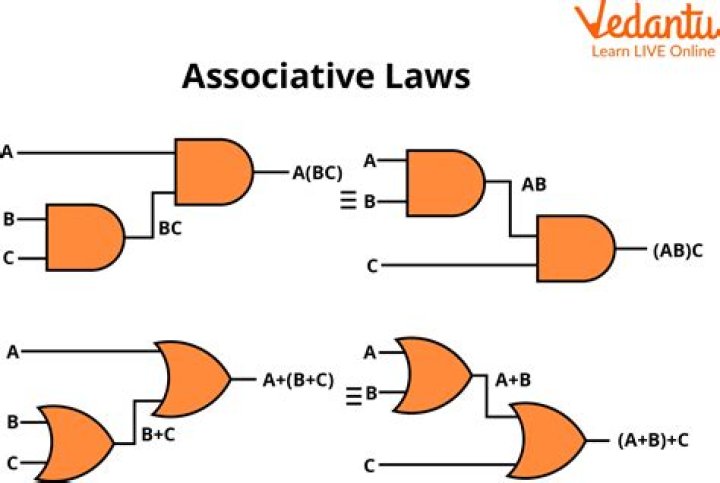
In this example
$$(\lnot p \lor q) \lor (\lnot p \lor r) \equiv (\lnot p \lor \lnot p) ∨ (q \lor r)$$
I can't seem to see how the associative law is applied here to be able to switch. Any hint or help would be appreciated
$\endgroup$1 Answer
$\begingroup$Intuitively
Notice that all the connectives are "or". In general, if you only have or's you can parenthesize the expression any way you want and it doesn't make a difference. This is because any way you parenthesize it, the expression will be true if at least one variable is true, and it will be false if every variable is false.
So I would just think of the expression as
$$¬p∨q ∨ ¬p∨r$$
And then switch the $q$ and $¬p$ (Commutative Law), since intuitively again it doesn't matter what order they're in it (for the same reason as above (consider when true/false)).
Thus we can transform it to
$$(¬p∨¬p) ∨ (q∨r)$$
$\endgroup$ 4