Audio issues during KVM switch
I currently have two computers connected to a KVM. One of the computers is connected to a spare display. Both computers are connected to an audio mixer. The KVM has DVI for video, and USB for the keyboard/mouse.
Anyway, sometimes I will start up a movie/video on the computer with the spare display, and put the window on the spare display, and then with the KVM switch to the other computer. Once I switch to the other computer Windows decreases all the audio volume for some reason, so the video which was playing great is barely audible.
Is there any way to disable this behavior, so I can have a video running on one computer, and be playing a game, or doing something else on the other?
The behavior seems to have nothing to do with the model of KVM attached since I have seen the behavior on 3 different KVMs, but since all the comments I have have gotten so far bring that up, I have included links to the models below. To repeat, I am NOT using the KVM audio ports, I have the audio from the computers directly routing into a mixer.
The audio does not return to the levels when I have reselected the computer. Here are some captures of the mixer before and after the switch. After a KVM switch I have to manually adjust the Windows mixer settings to get audio back to the normal level.
The Windows mixer before a KVM switch.
The Windows mixer after a KVM switch.
Ok, I have an update with an additional fact, but I really don't understand why it should be making a difference. The audio output from the on-board audio device in my computer is connected the mixer. Additionally, I have the USB audio adapter that comes with a logitech USB headset. I have a microphone connected to the adapter. So if I disconnect that adapter the audio levels do not change when I use the KVM to switch between computers. With that adapter connected, when I switch between computers the audio to the speakers drops to nearly 0, but not quite.
In the computer I have the on-board audio. I also
42 Answers
I believe I have finally figured this out.
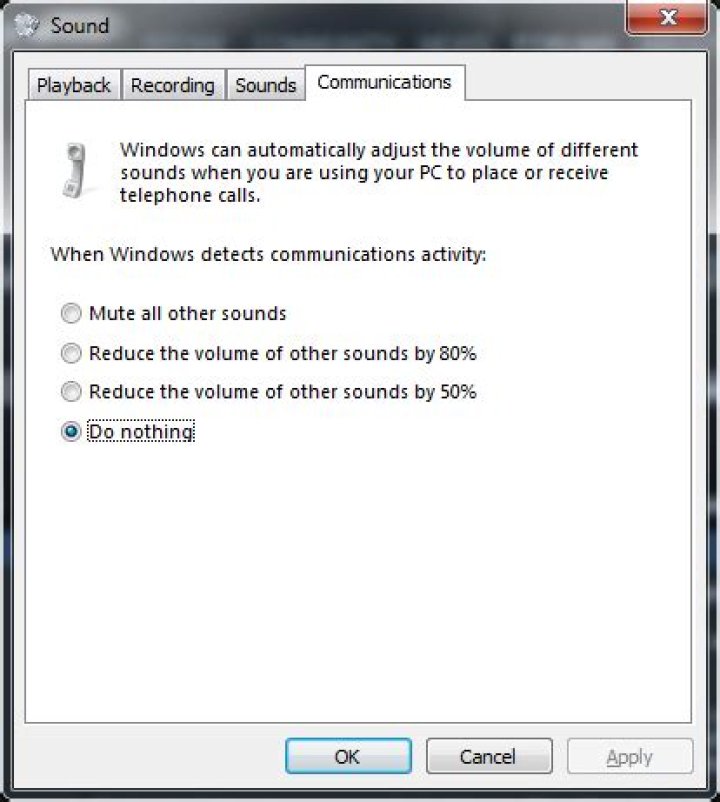
Apparently Windows 7 included a new feature to adjust the volume if you have communication software installed and the application decides there is a call taking place. The settings are found in Control Panel -> Sound -> Communications.
Apparently several different applications can trigger the volume changing like skype and steam both of which I happen to have running on my system.
I am still not entirely sure why it happens, but when I use the KVM to switch to different computer Steam seems to decide that everything else on my computer needs to have the volume muted by 80%. If I don't have my USB microphone connected, this doesn't happen. I suspect this may have something to do with the fact that the inexpensive KVM I have basically perform a USB disconnect of the keyboard/mouse, and that causes something to get confused and trigger the volume decrease.
I have disabled this 'feature', because it is not remotely useful for the way I use my systems, and I have not seen the symptoms any more.
Based on the KVM's you listed, I suspect the issue is a result of their abilities to control the Windows Volume through hotkeys. All 3 KVM's can change the Windows Volume through hotkey commands. When you switch between systems, the KVM will send commands via USB / Keyboard emulation to reduce the volume in Windows.
The audio connections on these KVM's do not have the ability to amplify or lower the volume of the signal - they just pass the audio along and rely on windows volume control to handle audio levels. While you are not using the audio cables - it is still functioning as if you are using the audio switching feature and lowering the volume to avoid interference issues or a big surprise when you come back to the other system and are blasted by loud music etc.
I recommend purchasing a KVM that does not have audio switching abilities.
EDIT: I would also avoid USB audio devices, such as your mic as it appears as an sound card and may further introduce issues like what you are experiencing.
12