Binary representation of 2-adic integers
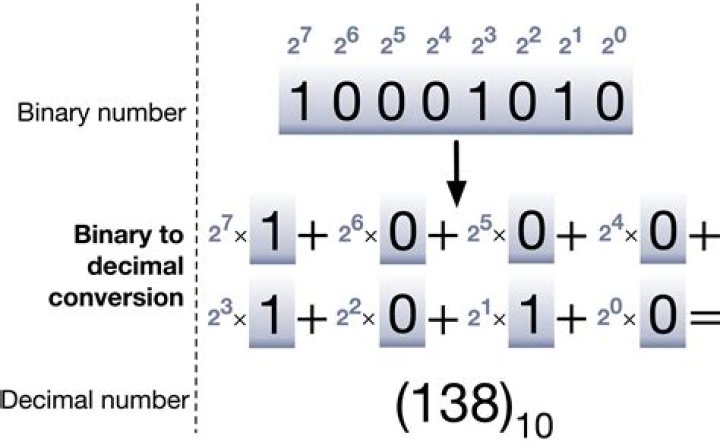
I would like some examples of the binary representation of 2-adic integers that are not standard integers. What is the 2-adic expansion of $1/3$? Of $-1/3$? What number does $...010101$ represent?
$\endgroup$2 Answers
$\begingroup$We can write arbitrary rationals in their $p$-adic expansions by utilizing modular arithmetic and geometric series. To begin with, let's reverse-engineer the form of $p$-adics with periodic digits.
Suppose $0\le a <p^s$. Then
$$n+p^r\sum_{n\ge1}ap^{sn}=n+\frac{ap^r}{1-p^s} $$
Bottom line: we want a denominator of the form $1-p^s$ and a numerator with $p$-free part that is less than the power $p^s$ appearing in the denominator.
We will see it suffices to consider negative rationals $-1<a/b<0$ with $p\nmid b<0$.
To get $1-p^s$ from the $b$ in $a/b$, we employ modular arithmetic. Since $p\nmid b$ we know $p$ is a unit modulo $b$ hence $p^s\equiv1\bmod b$ for some $s$. Let $1-p^s=bc$. Then
$$\frac{a}{b}=\frac{ac}{bc}=\frac{ac}{1-p^s}=ac+acp^s+acp^{2s}+\cdots $$
Furthermore $ac<p^s\Leftarrow ac-1<-bc\Leftarrow (a+b)c<1\Leftarrow a<-b$ so this gives a full expansion.
Now let's re-examine our sufficiency hypothesis. If $x=x_0+x_1p+\cdots$ is a negative rational,
$$-x=(p-x_0)+(p-x_1-1)p+(p-x_2-1)p^2+\cdots $$
is the complete $p$-adic expansion of the positive rational $-x$. Thus we're safe considering negative rationals. Furthermore given arbitrary $x\in\Bbb Q\setminus \Bbb Z$, we can use a combination of subtracting positive integers and negation in order to get $x$ in the interval $(0,1)$, after which we find the $p$-adic expansion and then add the integers back on (which will either perturb a finite number of digits or telescope in an obvious way, e.g. $1+(1+2+2^2+\cdots)$ in $\Bbb Q_2$).
Finally, powers of $p$ can be factored out of a rational and put back in after the expansion of the $p$-prime part has a $p$-adic expansion; powers of $p$ simply shift the digits left or right.
Let's apply this to a concrete example, say $-26/21$ in $\Bbb Q_3$. Factor the $3$ out to obtain $-26/7$, then negate to obtain $26/7$, then subtract $3$ to obtain $5/7$, then negate again for $-5/7$. Calculate powers to obtain $3^6\equiv1$ mod $7$ and $1-3^6=-7\cdot104$. Therefore compute
$$-\frac{5}{7}=\frac{\phantom{-}5\cdot104}{-7\cdot104}=\frac{520}{1-3^6}=520+520\cdot3^6+520\cdot3^{12}+\cdots.$$
As $520_{10}=201021_3$ the above is $\cdots\overline{201021}_3$. Hence
$$\begin{array} -\frac{26}{21} & =-\frac{1}{3}\left(3-\cdots\overline{201021}_3\right) \\ & =-\frac{1}{3}\left(11_3+\overline{021201}021202_3\right) \\ & =-\overline{021201}02122_3 \\ & =\overline{201021}20101_3. \end{array}$$
$\endgroup$ 6 $\begingroup$To answer your last question first, $$...010101 = 1 + 4 + 16 + \cdots + 4^n + \cdots = 1/(1-4) = -1/3.$$ This also answers your second question. As for your first question, $$1/3 = \dfrac{1}{2}( 1 - 1/3) = ...0101011.$$
$\endgroup$ 3More in general

"Zoraya ter Beek, age 29, just died by assisted suicide in the Netherlands. She was physically healthy, but psychologically depressed. It's an abomination that an entire society would actively facilitate, even encourage, someone ending their own life because they had no hope. Th…"

