Calculate $\sin^{-1} (\sin (45^\circ))$ without a calculator
We know that in this triangle, $h^2=a^2+a^2$. Therefore,
$$ h=\sqrt{a^2+a^2}=\sqrt{2a^2}=\sqrt{2}\:a\:. $$
As $h$ can be written as $\sqrt{2}\:a$, we now know how to write an expression for $\sin(45^\circ)$,
$$\sin(45^\circ)=\frac{a}{\sqrt{2}\:a}=\frac{1}{\sqrt{2}}\:.$$
Substitute $\sin(45^\circ)=\frac{1}{\sqrt{2}}$ into the expression $\sin^{-1} (\sin (45^\circ))$. Then
$$\sin^{-1} \left ( \frac{1}{\sqrt{2}} \right ) \:.$$
This means that
$$\alpha=\sin^{-1} \left ( \frac 1 {\sqrt 2} \right ) \tag 1$$
But how do I calculate $(1)$ without a calculator? It should be very simple, I think I'm just missing a concept here. I may have chosen the wrong method to calculate this expression, though.
$\endgroup$ 14 Answers
$\begingroup$What is the function $\sin^{-1} $? $\sin^{-1}(x) $ is asking for the angle whose sine is $x $.
What is $\sin^{-1}(\sin(x)) $? That is asking for the angle whose sine is the sine of $x $. Can you see the wordplay? What is the angle whose sine is the sine of $x $? Well, breaking it into smaller parts, let us assume the sine of $x$ is $y $. We have $\sin^{-1}(y) $: what is the angle whose sine is $y $? Well, from definition, $y = \sin(x) $ so $x $ is the angle whose sine is $y $. Thus the answer to "what is the angle whose sine is $y $?" is $x $. But that is the same as asking "What is the angle whose sine is the sine of $x $?" which has $x $ as an answer.
$\endgroup$ 0 $\begingroup$If $\alpha$ is an angle in quadrant 1 or 4 -- in the sense that $-90^\circ \le \alpha \le 90^\circ$, the inverse sine function undoes the the sine function. Thus $$\sin^{-1}(\sin(45^\circ))= 45^\circ.$$
$\endgroup$ $\begingroup$Hint:
By definition we have, for $0\le y\le 90°$: $$ \sin^{-1}(x)=y \quad \iff \quad \sin y=x $$
In your case we have $x=\sin(45°)$, so: $$ \sin y=\sin (45°) \quad \iff \quad y=45° $$
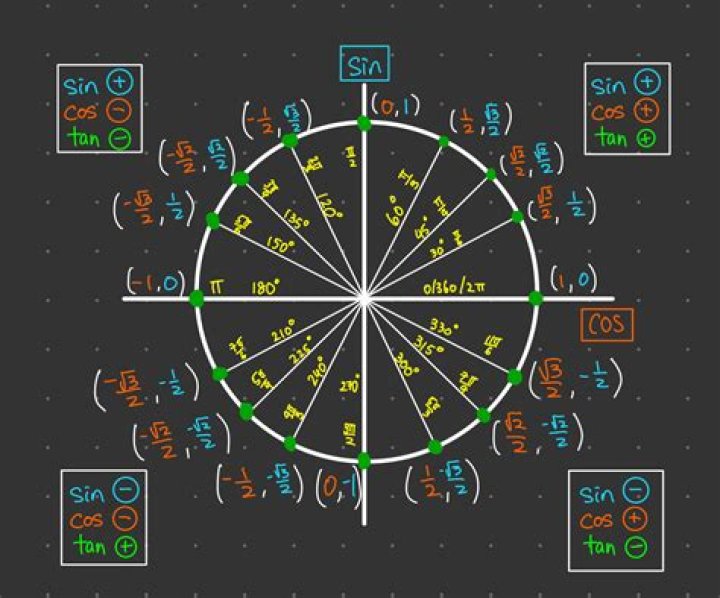
$\endgroup$ $\begingroup$If I understood your question correctly you're asking how to calculate $arcsin \left(\frac{1}{\sqrt(2)}\right)$ without a calculator (since you are referring to formula (1)). I would suggest the unit circle.
It's not that hard to memorize and a very important tool. But if you want to do it without memorizing you'll probably need to look at the origin of the sinus and cosines functions.
$\endgroup$