Can I cancel out factorials in proofs?
I encountered the following question in a discrete math course:
Prove that $ \binom{2n}{k-1} < \binom{2n}{k} $ for $k = 1, 2, \ldots , n$.
Hint: This should be a very cleanly written proof.
I'm working through this proof and I'm at a step where I have similar numerators but with a factorial.
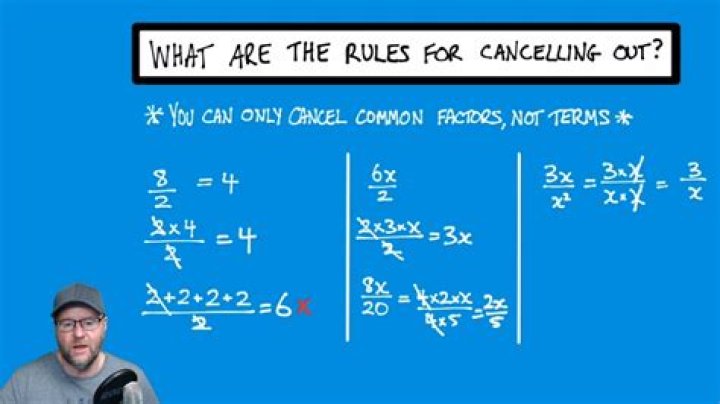
My question is: Can I "cancel out" factorials?
$\endgroup$ 22 Answers
$\begingroup$You can cancel, but you have to be careful how you do it. For example: $\frac{k!}{(k+1)!}$ can be reduced to $\frac{1}{k+1}$ by cancelling the factorial portion on top, but you CANNOT cancel like: $\frac{k!}{(k+1)!}=\frac{k}{k+1}$ effectively cancelling the "!" symbol.
Think about what the factorial means and it will be clear what you can do.
$$\frac{k!}{(k+1)!}=\frac{k(k-1)(k-2)...(3)(2)(1)}{(k+1)(k)(k-1)(k-2)...(3)(2)(1)}=\frac{1}{k+1}.$$
Other factorials are similar. Handy things to keep in mind are facts like $(n+1)!=(n+1)\cdot n!$, etc.
$\endgroup$ 1 $\begingroup$Hint: After you cancel out factorials, you will find out that $$ \frac{\binom{2n}{k}}{\binom{2n}{k-1}} = \frac{2n-k+1}{k} > 1. $$
$\endgroup$ 2