centered finite difference approximation
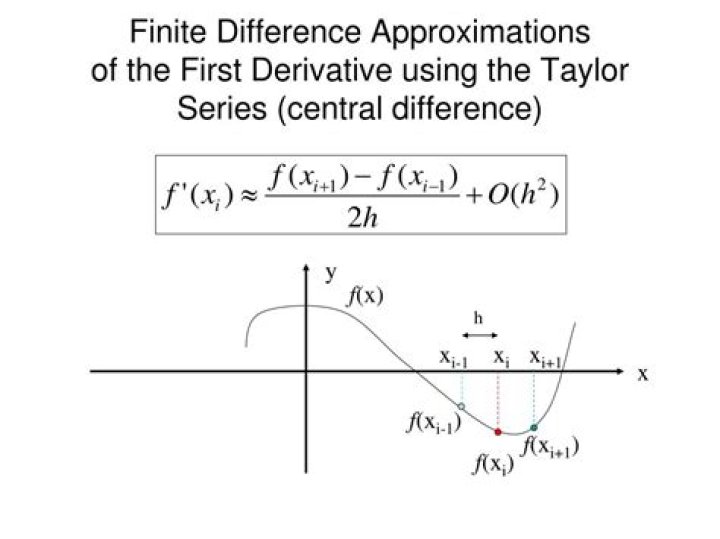
Show that the centered finite difference approximation for the first derivative of a function on a uniform mesh yields the exact derivative for any quadratic polynomial $P_2(x) = a+bx+cx^2$
Using the taylor series:
\begin{align} f(x+h) &= f(x) +f'(x)h + f''(x) \frac{h^2}{2}+f'''(x)\frac{h^3}{6}+ \dots \\ f(x-h) &= f(x) -f'(x)h + f''(x) \frac{h^2}{2}-f'''(x)\frac{h^3}{6}+ \dots \end{align}
From the first equation, we get the forward difference approximation:$$f'(x) = \frac{f(x+h)-f(x)}{h}+O(h).$$
From the second equation, we get the backward difference approximation$$f'(x) = \frac{f(x)-f(x-h)}{h}+O(h),$$
and if we subtract the second equation from the first equation we get$$f'(x) = \frac{f(x+h)-f(x-h)}{2h}+O(h^2),$$
which is the central difference formula.
But how do I use this to solve my problem? Is this formula the same as the centered finite difference approximation mentioned in the question?
$\endgroup$2 Answers
$\begingroup$You've well applied Taylor's expansion.
\begin{align} f(x+h) &= f(x) +f'(x)h + f''(x) \frac{h^2}{2}+f'''(x)\frac{h^3}{6}+ o(h^3) \tag1 \label1 \\ f(x-h) &= f(x) -f'(x)h + f''(x) \frac{h^2}{2}-f'''(x)\frac{h^3}{6}+ o(h^3) \tag2 \label2 \end{align}
$$\frac{\eqref{1} - \eqref{2}}{2} : \frac{f(x+h)-f(x-h)}{2} = f'(x)h + f'''(x)\frac{h^3}{6} + o(h^3) \tag{3}\label{3}$$
When the above equality is applied to a quadratic polynomial, we have $f^{(n)} \equiv 0$ for $n \ge 3$, so only the first derivative remains. This should give you the desired result
$$f'(x) = \frac{f(x+h)-f(x-h)}{2h}. \tag{4}\label{4}$$
(Edit in response to OP's request)
Apply given formula$$f'(x) = \frac{f(x+h)-f(x-h)}{2h}+O(h^2) \tag5\label5$$to $P_2(x)$.
$$\begin{aligned} P_2'(x) &= \frac{P_2(x+h)-P_2(x-h)}{2h}+O(h^2) \\ &= \frac{(a-a)+b[(x+h)-(x-h)] + c[(x+h)^2-(x-h)^2]}{2h}+O(h^2) \\ &= \frac{b(2h) + c[(x+h)+(x-h)][(x+h)-(x-h)]}{2h}+O(h^2) \\ &= \frac{2bh + c(2x)(2h)}{2h}+O(h^2) \\ &= b+2cx + O(h^2) \end{aligned} \tag6\label6$$
Since \eqref{5} actually comes from dividing \eqref{3} by $2h$, and the third and higher derivatives in \eqref{3} vanishes when $f = P_2$, therefore, we can discard $O(h^2)$ in \eqref{6} and conclude that the central finite difference approximation for the first derivative is exact when $f = P_2$.
- When $O(h)$ is used to describe a particular function, it's used as an object. In symbols: $f = O(h)$.
- When $O(h)$ is used as a subject, it describes a class of functions bounded by $Mh$ for a certain constant $M>0$.
When $P_{2}'(x) = b+2cx +O(h^2)$,$$P_{2}'(x) - (b+2cx) = (b+2cx +O(h^2)) - (b+2cx) = O(h^{2}).$$We won't say $O(h^2) = 0$ in general. Instead, we need to make use of the given conditions to conclude further.
$\endgroup$ 21 $\begingroup$This is the centered finite difference approximation method,
basically you need to apply it to the general polynomial:
$f′(x)=\dfrac{f(x+h)−f(x−h)}{2h}+O(h^2)$ is what you already got
$P_{2}'(x)=\dfrac{(a+b(x+h)+c(x+h)^2) -(a+b(x-h)+c(x-h)^2)}{2h} +O(h^2)$
$P_{2}'(x)=\dfrac{a(1-1)+b(x+h-x+h)+c(x^2+2hx+h^2-x^2+2xh-h^2)}{2h} +O(h^2)$
$P_{2}'(x)=\dfrac{b(2xh)+c(4xh)}{2h} +O(h^2)$
$P_{2}'(x)=b+2cx +O(h^2)$
Hence :
$P_{2}'(x) - (b+2cx) = b+2cx - b-2cx = 0 = O(h^{2})$, here we stating that the error goes to 0, it is also possible to see that $P_{2}''(x+h)-P_{2}''(x+h)=0$ and the higher order derivatives are $0$, so this statement is equivalent