Closed Interval Method
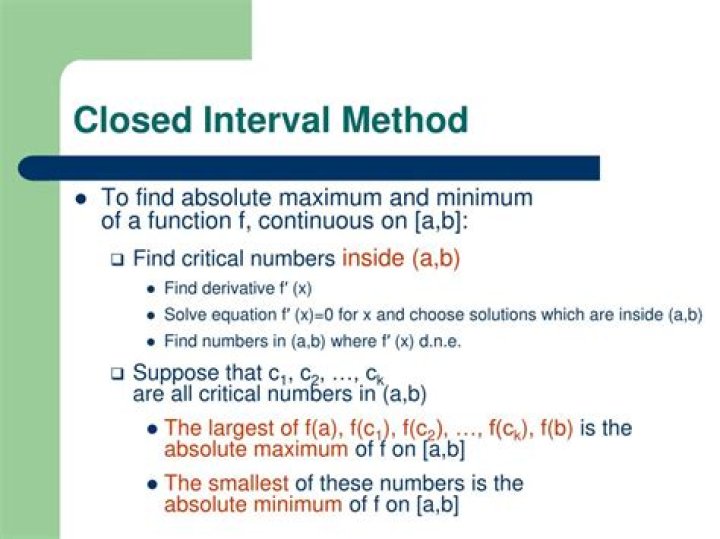
From the book "Calculus" by James Stewart,
The Closed Interval Method is used to find the absolute(global) maximum and minimum values of a continuous function on a close interval $[a,b]$.
1) Find the values of $f$ at the critical numbers of $f$ in $(a,b)$.
2) Find the values of $f$ at the endpoints of the interval.
3) The largest of the values from Steps 1 and 2 is the absolute maximum value; the smallest of these values is the absolute minimum value.
I have problem understanding step 1.
Fermat's Theorem states that if function $f$ has local maximum/minimum at point $x=a$, then $a$ is a critical number.
Also the converse is not true as the function $y=x^3$ has a critical point at $x=0$ but $x=0$ is not a local minimum/maximum.
Also, from my understanding, absolute minimum/maximum on an closed interval can either be a local min/max on the closed interval or at the end points.
Hence, we should find the local minimum/maximum and compare the values with the value of function at the endpoints.
But from the example of $y=x^3$, doing step 1) as suggested in the book can derive point that is a critical number but not a local minimum/maximum.
Perhaps, it is proven such points can never be the absolute maximum/minimum?
Edit: knowing such point $a$ is not a local minimum/maximum tells us that there exist $x$ such that $f(x) > a$ and $f(x) < a$ and the absolute maximum/minimum would either be another critical number or at the end points.
$\endgroup$1 Answer
$\begingroup$Step 1 is just part of the whole story. And you are right that Step 1 would give points that are not absolute min/max. That's exactly why you need Step 2 and Step 3.
In the case of $f(x)=x^3$ (say in $[-1,1]$), it is true that you will get $x=0$ as a critical number. However, Step 2 and Step 3 will rule it out.
[Added to answer the question in the comment:] Because global min/max must also be local min/max. If a critical point is not a local min/max, then it cannot be global min/max.
$\endgroup$ 7