Composition of two reflections is a rotation
I have this problem that says: Prove that in the plane, every rotation about the origin is composition of two reflections in axis on the origin.
First I have to say that this is a translation, off my own, about a problem written in spanish, second, this is the first time I write a geometry question in english.
I don't know how to prove this, so I made a few drawings, but I believe I got more confused. I put a point P in the plane and then rotate it $\theta$ from the X axis and got $P_\theta$, I assume that what the problem wants is to get from P to the same $P_\theta$ but with two reflections, this is what I don't understand, why do we need two? if we bisect the angle that P and $P_\theta$ formed then we get an axis that works as the axis of reflection, then we don't need two, but one to get the same point.
Please tell me what's going on here.
I know that we can see rotations and reflections as matrix, should I try to multiply two reflections with different angles and then see if I can rewrite the result as a rotation?
$\endgroup$ 42 Answers
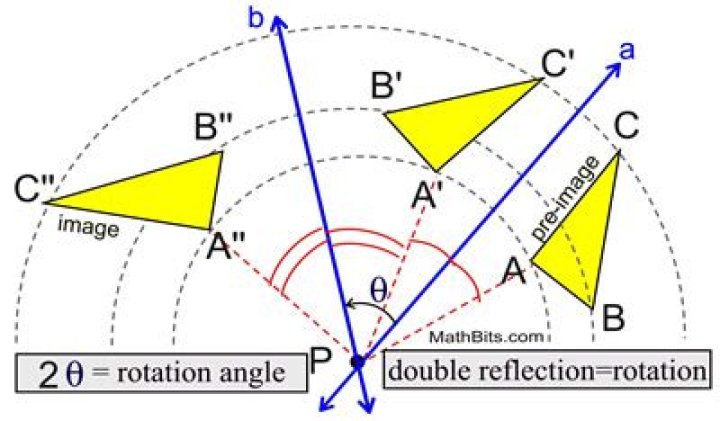
$\begingroup$Please see this diagram. Lines $m,n$ are normals to reflexive axes with the angle between them $\frac\theta2$. Then $v''$, which is reflected twice by $m,n$ is such a vector rotated $\theta$ from the original vector $v$.
And I think this has also an algebraic explanation in geometric algebra. The reflection of $v$ by the axis $n$ is represented as $v'=-nvn$. Then $v''=-mv'm=-m(-nvn)m=(mn)v(nm)=RvR^\dagger$, where $R=mn$ and $R^\dagger$ is reverse of $R$. We speak of $R$ is rotor of angle $\theta$ if $m\cdot n=\cos\frac\theta2$. $RvR^\dagger$ is exactly the expression of a rotation in geometric algebra.
$\endgroup$ $\begingroup$If you draw a circle around the origin, and then reflect a point in two straight lines at an angle $\theta$, the point rotates $2\theta$.
Multiplying the matrices will show this.
While one can produce a rotation by two mirrors, not every rotation implies the existence of two mirrors. Rotating things by 120 deg will produce three images, not six.
$\endgroup$ 1