Confusion about Notation of the Cardinality of a Set
One textbook I'm reading says that the definition of two sets having the same cardinality is as follows:
"Two sets A and B have the same cardinality if there exists a bijection $f:A \rightarrow B$."
It also says that $|A|$ denotes the equivalence class of all sets having the same cardinality of A. So since equivalence classes in general are sets, then that would mean that $|A|$ is a set.
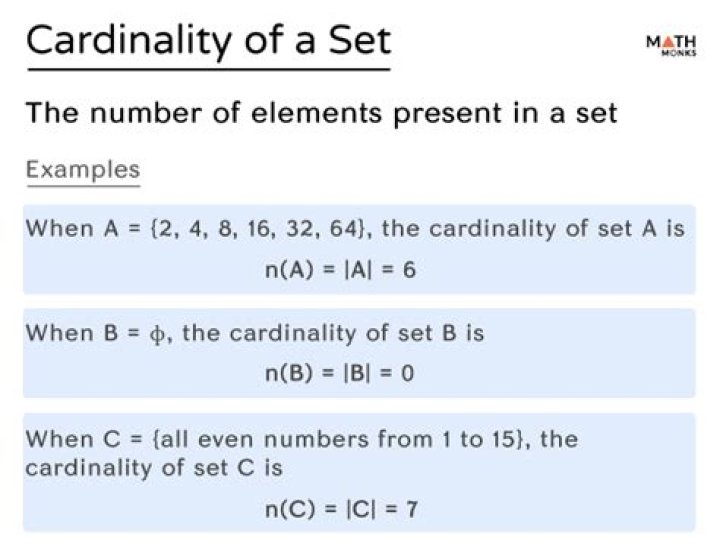
However later on, the textbook wants us to write $|A| = n$ if $A$ has the same cardinality as the set {$1, 2, ..., n$}. Doesn't that contradict the whole meaning of $|A|$ being an equivalence relation then, since $n$ is not a set but instead a natural number?
Thanks in advance.
$\endgroup$ 41 Answer
$\begingroup$Set theory does not allow one to form a set out of all sets with cardinality $3$, say. Nor even a set of all sets with any given cardinality (except for the cardinality $0$, for which $\{\{\}\}$ does the trick). The existence of such a set would contradict the axioms of set theory, in a manner similar to Russell's paradox. So no, it is not true that "equivalence classes in general are sets".
This leaves one with the problem: Is there a way to sidestep this issue? Perhaps some way to naturally choose a single set in each "equivalence class"? Perhaps even a way to define cardinal numbers by making such a choice in some set theoretically natural manner?
This problem is solved by a lot of things with John Von Neumann's name attached to them: the Von Neumann notation for natural numbers, and more generally the Von Neumann notation for ordinal numbers, coupled with the Von Neumann assignment for cardinal numbers.
$\endgroup$ 10