Conjugate of complex polynomial?
Say I have a complex polynomial:
$$a_0+a_1x+\cdots+a_nx^n,$$
where $a_0,\ldots,a_n$ are complex numbers.
What is the conjugate of this polynomial? How is it defined?
For example, if we have an inner product on the vector space $V$ defined by (for complex polynomials):
$$\int_0^1 p(x)\overline{q(x)}dx$$
Then how do we know that:
$$\langle v,v \rangle = \int_0^1 (a_0+a_1x+\cdots+a_nx^n)(\overline{a_0}+\overline{a_1}x+\cdots+\overline{a_n}x^n)dx$$
is positive? Since there could be negative numbers in there, do we just know the positive ones outweigh the negative?
2 Answers
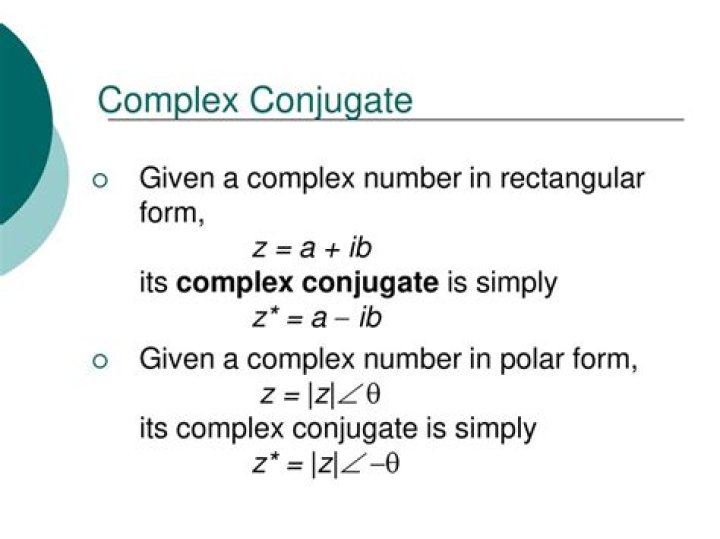
$\begingroup$It is simply the polynomial you get by replacing each $a_i$ by its complex conjugate.
You should think of this as the map induced on $\mathbb{C}[x]$ by the map $\mathbb{C}\to\mathbb{C}$ given by complex conjugation.
Added: How do we know that $\int_0^1 p(x)\overline{p(x)}\,dx$ is positive?
Write each $a_j = \alpha_j + i\beta_j$, with $\alpha_j,\beta_j\in\mathbb{R}$. Then note that $v = q(x)+ir(x)$, where \begin{align*} q(x) &= \alpha_0 + \alpha_1 x + \cdots + \alpha_nx^n\\ r(x) &= \beta_0 + \beta_1x + \cdots + \beta_nx^n. \end{align*} So you have: \begin{align*} \langle v,v\rangle &= \int_0^1 (a_0+a_1x + \cdots + a_nx^n)(\overline{a_0}+\overline{a_1}x + \cdots \overline{a_n}x^n)\,dx\\ &= \int_0^1(q(x)+ir(x))(q(x)-ir(x))\,dx\\ &= \int_0^1\Bigl( \left(q(x)\right)^2 - i^2\left(r(x)\right)^2\Bigr)\,dx\\ &= \int_0^1\Bigl( \left(q(x)\right)^2 + \left(r(x)\right)^2\Bigr)\,dx \end{align*} and since this is the integral of two nonnegative real valued functions, it is nonnegative (and equal to $0$ if and only if both $q(x)$ and $r(x)$ are zero, i.e., if and only if $v=\mathbf{0}$).
$\endgroup$ 6 $\begingroup$As has been pointed out in the comments, the conjugate of a polynomial has different meanings, depending on the context. In the expression$$ \langle p, q \rangle := \int_0^1 p(x)\overline{q(x)}\, dx $$the quantity $\overline{q(x)}$ is the complex conjugate of $q(x)$, i.e., the complex conjugate of the number that you obtain by evaluating $p$ at $x$. Note that $x \in \mathbb{R}$, which we shall assume in the following.
Let us consider the term $\overline{p(x)}$, and let $p(x) = a_0 + a_1 x + a_2 x^2 + \cdots + a_n x^n$. Then, using the rules for complex conjugation, we obtain that$$ \begin{aligned} \overline{p(x)} &= \overline{a_0 + a_1 x + a_2 x^2 + \cdots + a_n x^n} \\ &= \overline{a_0} + \overline{a_1} \cdot \overline{x} + \overline{a_2} \cdot \overline{x}^2 + \cdots + \overline{a_n} \cdot \overline{x}^n \,. \end{aligned} $$Since we have assumed that $x \in \mathbb{R}$,$\overline{x} = x$, and thus$$ \overline{p(x)} = \overline{a_0} + \overline{a_1} \cdot x + \overline{a_2} \cdot x^2 + \cdots + \overline{a_n} \cdot x^n =: \overline{p}(x) \,. $$So in our setting, it makes sense to call the term in the middle the conjugate of $p$.
Regarding the second part of your question, we have that$$ \int_0^1 (a_0 + a_1 x + \cdots + a_n x^n) (\overline{a_0} + \overline{a_1} \cdot x + \cdots + \overline{a_n} \cdot x^n) \,dx = \int_0^1 p(x) \overline{p(x)}\, dx \,, $$and we know that $z\overline{z} \ge 0$ for every complex number $z$, since$$ \newcommand{\I}{\mathrm{i}} z \overline{z} = (a + \I b)(a - \I b) = a^2 + b^2 \quad\text{for}\quad z = a + \I b \,. $$Thus $p(x) \overline{p(x)} \ge 0$, and therefore,$$ \int_0^1 p(x) \overline{p(x)}\, dx \ge 0 \,. $$Furthermore, since the integrand is continuous, the integral is only zero if and only if $p \equiv 0$. Hence, we have shown the desired statement.
Again note, that all of the above assumes that $x \in \mathbb{R}$. If $z \in \mathbb{C}$ there exists in general no polynomial $q$ such that $q(z) = \overline{p(z)}$ for the following reason. If $p(z) = z$, then we would need that $q(z) = \overline{p(z)} = \overline{z}$. Thus $q(z)$ would be the complex conjugation. We know, however, that the complex conjugation is not analytic and thus cannot be a polynomial. (All polynomials are analytic.) Hence in the case of polynomials over complex fields we have especially that in general $\overline{p(z)} \neq \overline{p}(z)$.
$\endgroup$