Counter-example of Cavalieri's principle
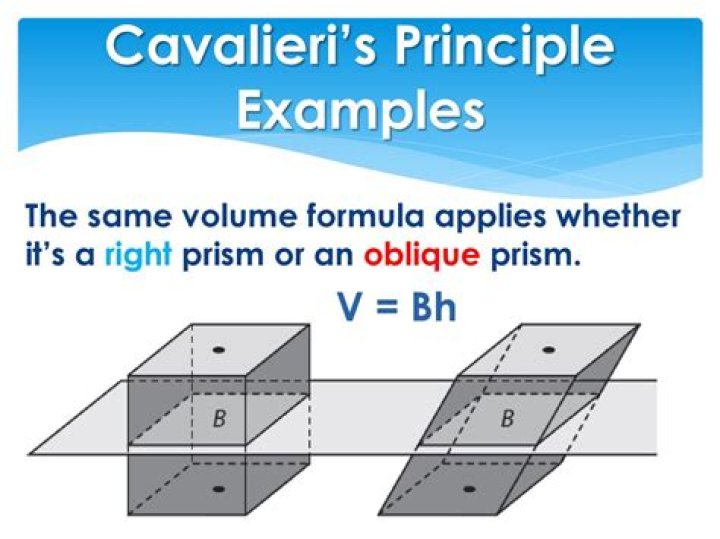
Suppose $S$ is a given solid and $L$ a given line. If a plane $F$ is perpendicular to $L$, the intersection $F\cap S$ is called cross section perpendicular to $L$. If every cross-section perpendicular to $L$ is a measurable set in its own plane, we call $S$ a Cavalieri solid. Cavalieri's principle assigns equal volumes to two Cavalieri solids, $S$ and $T$, if $a(F\cap S) = a(F \cap T)$ for every plane $F$ perpendicular to a given line $L$.
Doubts
- Can this principle be stated in simpler terms?
- Are there any example of solids which are not Cavalieri solids
Definition given in Wikipedia-
Suppose two regions in three-space (solids) are included between two parallel planes. If every plane parallel to these two planes intersects both regions in cross-sections of equal area, then the two regions have equal volumes.
How this is equivalent to the above definition?
1 Answer
$\begingroup$I think that your first $5$ lines and the Wikipedia text say exactly the same thing, and it cannot be said in simpler terms.
If you accept the existence of nonmeasurable sets then there will also be noncavalieri solids.
Now Cavalieri's principle is a consequence of Fubini's theorem (or similar statements) in the special case where $f(x,y,z)\equiv1$: For a compact solid $S\subset{\mathbb R}^3$ one defines $$ S':=\bigl\{z\in \mathbb R \bigm|\exists\> (x,y,z)\in S\bigr\},\qquad S_z:=\bigl\{(x,y)\in{\mathbb R}^2\bigm| (x,y,z)\in S\bigr\}\quad(z\in S')\ .$$ Hence $S'$ is the projection of $S$ onto the $z$-axis, and for each $z\in S'$ we consider the shape $S_z$ in $(x,y)$-space ${\mathbb R}^2$, created by intersecting $S$ with the horizontal plane at level $z$. Then $${\rm vol}(S):=\int_S 1\>{\rm d}(x,y,z)=\int_{S'}\left(\int_{S_z}{\rm d}(x,y)\right)\>{\rm d}(z)=\int_{S'}{\rm area}(S_z)\>{\rm d}(z)\ .$$
$\endgroup$