Difference between "work" and "flux/flow" in multivariable calculus?
I am in the multivariable calculus class now and trying to understand things. What is the difference between "work" and "flux/flow" in multivariable calculus?
Exam questions usually ask: "find work done..." or "find flux...", so:
- Is work done, work actually done along a line, so use line integral (single integral) over vector field?
- Is flux/flow a flow through a surface so use one of: surface, green, stokes, divergence theorems (double/tripple integrals)?
- Can work done be calculaed using green, stokes or divergence theorems?
- Is work done actually the same thing as flux/flow, just another name?
1 Answer
$\begingroup$1. Yes, work is always relative to a curve $\gamma$ and a vector field $\vec{F}$ which is defined on $\gamma$. The definition itself is the line integral, and work is a different name to the same thing: $\int_I \vec{F}(\gamma(t))\cdot \gamma'(t)\text{d}t$
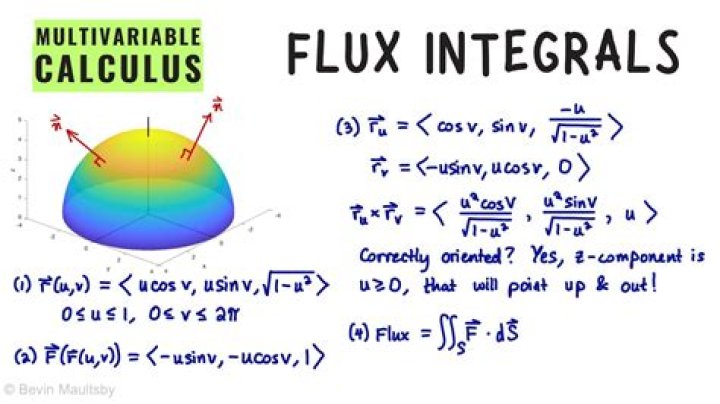
2. You could use each of these theorems to calclate surface integrals in an alternative way (using triple integrals or work integral, depends on the theorem). You could also calculate the surface integral using its definition $\iint_\Omega \vec{F}(\varphi(u,v))\cdot \left ( \varphi_u \times \varphi_v \right ) \text{d}u\text{d}v$.
3. If you look at those theorems, you see Green and Stokes' include a line integral on one side, and the Divergence theorem doesn't. So the answer is it depends: if for some reason it is easier to calculate $\iint_S \vec{\nabla}\times \vec{F}\cdot \text{d}\vec{\sigma}$ or $\iint_D Q_x-P_y \text{d}x\text{d}y$ then you could infact get the work intgral in a way which doesn't involve using the definition.
4. Flux is a different notion from work even though they use similar concepts. Work is a measure of how much $\vec{F}$ agrees with $\gamma'$. It is maximal when the field is tangent to the field at every point. However, in surfaces, flux tells us how much $\vec{F}$ tries to "go through" the surface. In contrast, it is maximal when $\vec{F}$ is perpendicular to the surface at every point.
I would like to points out to avoid confusion, that there are different kinds of line integrals and surface integrals which involve scalar functions rather than vector fields.
$\endgroup$