Distinguishing between Laplace's equation and heat equation?
I have a pde $$\frac{\partial^2 u}{\partial x^2}=\frac{1}{c^2} \frac{\partial u}{\partial t}$$ I have been told this is a heat equation. Why? What are the distinguishing features between the heat equation and the Laplace equation?
$\endgroup$ 44 Answers
$\begingroup$One often divides PDEs into three main types, depending essentially on the order of the derivatives involved, and the sign in front of those derivatives:
Elliptic: all derivatives are second-order, all signs are positive. Example: $\partial^2_{xx} + \partial^2_{yy} + \partial^2_{zz}$, Laplace's equation.
Hyperbolic: all derivatives are second-order, one sign is negative, the rest are positive. Example: $-\partial^2_{tt} + \partial^2_{xx} + \partial^2_{yy}$, the wave equation.
Parabolic: one derivative is first order, the rest are second order, one sign is negative (corresponding to the "one derivative" term), the rest are positive. Example $-\partial_{t} + \partial^2_{xx} + \partial^2_{yy}$, the heat equation.
This is, of course, greatly oversimplifying things, but we tend to break our equations up into these categories because, within a particular category, similar characteristics are exhibited. For instance, parabolic equations smooth data instantly (even if the initial data for a heat equation has discontinuities, for any time $t > 0$, the solution is smooth), hyperbolic equations on the other hand propagate their singularities in a predictable way (along rays).
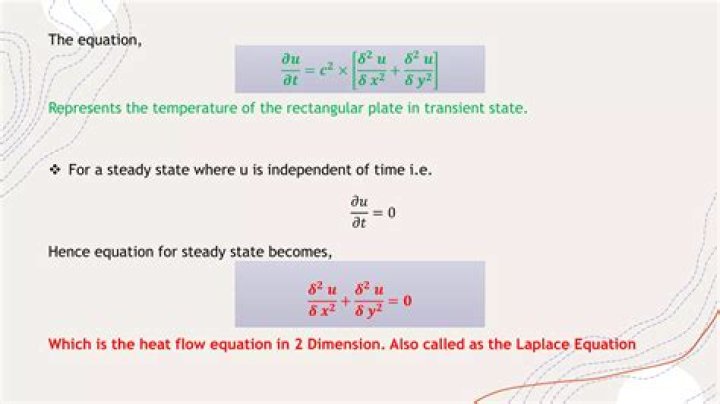
$\endgroup$ $\begingroup$I'm currently learning these topics as well, so someone will correct me if I'm wrong. What I've been taught though, is that in a certain sense, all heat equations "contain" a lower dimensional Laplace equation. This "certain sense" means that, for a fixed $t$, the equation becomes $$\frac{\partial ^2 u}{\partial x^2} = 0$$ This is in fact a Laplace equation in one dimension as the Laplacian of a real function of one real variable $f(x)$ is just $f''(x)$ ($= \frac{d^2f}{dx^2}$, if you wish). In higher dimensions, the homogeneous heat equation is just $$u_t -D\Delta u = 0 $$ for some diffusion constant $D > 0$. The Laplace equation for a fixed $t$ then, is $$\Delta u = 0$$
Viewing the heat equation this way is in fact a useful method for solving it, because we can then express a solution in terms of the eigenvectors/eigenfunctions (and their corresponding eigenvalues) of the Laplace operator. This view of the heat equation also comes in play when we study "steady-state solutions", aka what the solution tends to (if it does), as $t\to \infty$.
To state this all precisely, we consider the function $u(x,t)$ as a different function of $x$ for each $t$, and denote each of these functions for their corresponding $t$ as $u(\cdot,t)$. The difference between Laplace and heat equations is now clearer (whether or not this is "clearer" is a matter of familiarity with the terms in question): the Laplace equation is a linear equation in infinite dimension: $$\Delta u(\cdot,t) = 0$$
Whereas the heat equation is a (linear) ordinary differential equation, also in infinite dimension: $$\frac{d}{dt}u(\cdot,t) = D\Delta u(\cdot,t)$$
The infinite dimension comes from the fact that the value of $u(\cdot,t)$ for each $t$ is a function (of spatial variables $\mathbf x$). The set of such funtions is an infinite-dimensional vector space.
With all of this in mind, we can make an analogy in finite dimension: one thing is solving a linear equation $$Ax = b$$ and another is solving a linear ODE: $$\frac{d}{dt}y = Ay$$
If you understand this difference, it should help you understand the "distinguishing features", as you say, of the Laplace equation vs. the heat equation, bearing in mind that not all from finite dimension carries over to infinite dimension (but some things are quite the same!).
$\endgroup$ $\begingroup$The Laplace equation applies when your length scale is small so it can be assumed $c\rightarrow\infty$ and in this case the diffusion equation becomes the Laplace equation. This is a key physical point.
Because there is no time derivative in the Laplace equation, it suggests information travels infinitely fast which is physically impossible. So every physical situation where the Laplace equation applies is actually another equation like the wave equation or the diffusion equation.
It can also be viewed as the steady state version of the heat equation.
$\endgroup$ $\begingroup$One distinguishing feature is that the heat equation involves the first derivative with respect to time whereas Laplace's involves only second derivatives.
$\endgroup$