Euler's formula for complex $z$
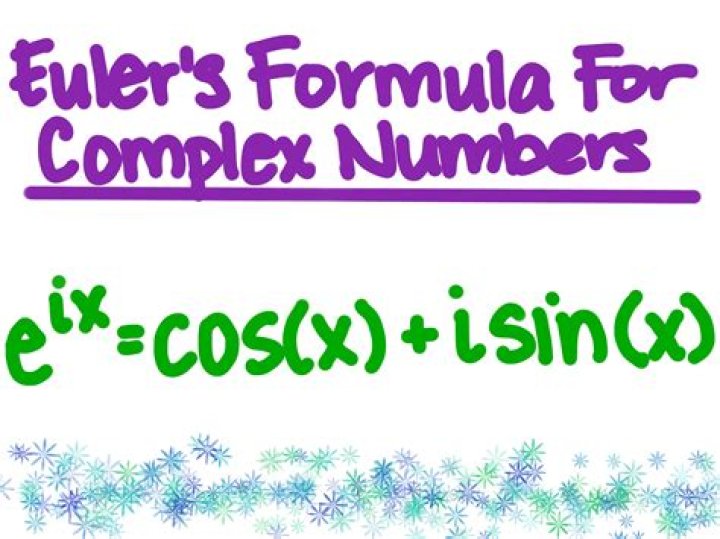
Given Euler's formula $e^{ix} = \cos x + i \sin x$ for $x \in \mathbb{R}$, how does one extend this definition for complex $z$? I.e for $z \in \mathbb{C}, $ show that $e^{iz} = \cos(z) + i\sin(z)$?
I can reexpress $z = x+$i$y\,$ for $x,y \in \mathbb{R}$ and then substitute into the above to get $e^{ix}e^{-y} = (\cos x + i\sin x)e^{-y}$, but I am unsure of how to progress. I am hoping this can be done without appealing to the complex $\sin$ and $\cos$.
Thanks.
$\endgroup$ 34 Answers
$\begingroup$Let $z=x+iy$, and you want to show that $e^{iz}=\cos(z)+i\sin(z)$ i.e. Euler's formula applies to complex $z$.
I will prove the formula starting from the right hand side.
I don't think you can get away from complex trigonometry, where the cosine/sine of a purely imaginary term is defined as a hyperbolic function as follows:-
$\cos(ix)=\cosh(x)$
$\sin(ix)=i\sinh(x)$
Using the above definitions in conjunction with the sum of angles identities, we have
$\cos(x+iy)=\cos(x)\cos(iy)-\sin(x)\sin(iy)=\cos(x)\cosh(y)-i\sin(x)\sinh(y)$
$\sin(x+iy)=\sin(x)\cos(iy)+\cos(x)\sin(iy)=\sin(x)\cosh(y)+i\cos(x)\sinh(y)$
So we have
$\cos(x+iy)+i\sin(x+iy)\\=\cos(x)\cosh(y)-\cos(x)\sinh(y)+i(\sin(x)\cosh(y)-\sin(x)\sinh(y))\\=\cos(x)e^{-y}+i\sin(x)e^{-y}=(\cos(x)+i\sin(x))e^{-y}=e^{ix}e^{+i^2y}=e^{i(x+iy)}=e^{iz}$
where we have used the fact that $\cosh(y)-\sinh(y)=e^{-y}$
$\endgroup$ 5 $\begingroup$First, note that if $e^x = \cos x + i\sin x$, then $e^{-x} = \cos x - i\sin x$. Adding these equations yields $$\cos x = \frac{e^{ix} + e^{-ix}}{2}.$$ Similarly, subtracting $e^{-x} = \cos x - i\sin x$ from $e^x = \cos x + i\sin x$ gives $$\cos x = \frac{e^{ix} - e^{-ix}}{2i}.$$
Consider $e^{iy} = \cos y + i\sin y$, where $y \in \mathbb{R}$. Now let $x \in \mathbb{R}$ and multiply both sides by $e^x$ to obtain $$e^{x + iy} = e^x(\cos y + i\sin y).$$ Let $z = x + iy$. Then $$e^{z} = e^x(\cos y + i\sin y).$$ Lastly, raise both sides to the $i$-th power to get $$e^{iz} = e^{ix}(\cos y + i\sin y)^i = (\cos x + i\sin x)(\cos y + i\sin y)^i.$$
Your question is a little confusing. If you simply want to prove that $e^{iz} = \cos z + i\sin z$, for all complex $z$, use complex power series. The proof is trivial. In complex analysis one often defines the exponential function, the cosine function, and the sine function, respectively, by $$e^{z} = \sum_{n = 0}^\infty \frac{z^n}{n!}, \quad \cos z = \sum_{n = 0}^\infty (-1)^n \frac{z^{2n}}{(2n)!}, \quad \text{and} \quad \sin z = \sum_{n = 0}^\infty (-1)^n \frac{z^{2n + 1}}{(2n + 1)!}, \quad z \in \mathbb{C}.$$
The reason why we define complex functions by power series in complex analysis is rather simple. For instance, $\sin z$ does not make sense if you regard $\sin z$ as the usual sine function because complex angles do not exist! It is absurd to define an angle that cannot be measured. Angles, by definition, are measurable quantities. So, in truth, complex functions such as $e^z$, $\cos z$, $\sin z$, etc. are the analogues (or the generalizations) of their real counterparts. Nonetheless, we see that \begin{align*} e^{iz} &= \sum_{n = 0}^\infty \frac{(iz)^n}{n!}\\ &= 1 + iz - \frac{z^2}{2!} - i\frac{z^3}{3!} + \frac{z^4}{4!} + i\frac{z^5}{5!} - \cdots\\ &= \left(1 - \frac{z^2}{2!} + \frac{z^4}{4!} - \cdots\right) + i\left(z - \frac{z^3}{3!} + \frac{z^5}{5!} - \cdots\right)\\ &= \cos z + i \sin z. \end{align*}
This also proves that $\cos z + i \sin z = (\cos x + i\sin x)(\cos y + i\sin y)^i$.
$\endgroup$ 0 $\begingroup$Actually, complex sine and cosine are DEFINED in order to satisfy Euler's formula.
In fact, $\cos z$ and $\sin z$ are defined as $$ \cos z=\frac{\mathrm{e}^{iz}+\mathrm{e}^{-iz}}{2},\quad \sin z=\frac{\mathrm{e}^{iz}-\mathrm{e}^{-iz}}{2i}. $$
Also, the same exactly definition for $\cos T$, $\sin T$ is given when $T$ is a square matrix or even a bounded operator on Banach spaces.
$\endgroup$ 6 $\begingroup$It sounds like you're really asking how to define $\exp(z)$. Acommon method is to simply define it by its power series
$$ \exp(z) := \sum_{n=0}^{\infty} \frac{z^n}{n!} $$
Then you can define $\cos(z)$ and $\sin(z)$ in terms of $\exp(z)$. Or, you can define them in terms of their power series; if you take that approach, checking the identity by plugging in the power series is straightforward.
$\endgroup$ 2