Find the derivative using the chain rule and the quotient rule
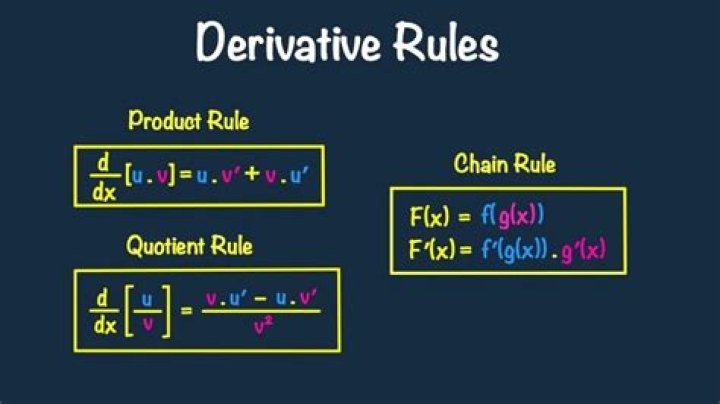
$$f(x) = \left(\frac{x}{x+1}\right)^4$$ Find $f'(x)$.
Here is my work:
$$f'(x) = \frac{4x^3\left(x+1\right)^4-4\left(x+1\right)^3x^4}{\left(x+1\right)^8}$$
$$f'(x) = \frac{4x^3\left(x+1\right)^4-4x^4\left(x+1\right)^3}{\left(x+1\right)^8}$$
I know the final simplified answer to be:
$${4x^3\over (x+1)^5}$$
How do I get to the final answer from my last step? Or have I done something wrong in my own work?
$\endgroup$ 66 Answers
$\begingroup$You calculation of $f'(x)$ is correct, though it can be simplified. To do this, we factor out $4x^3(x+1)^3\require{cancel}$ in the numerator.
$$\begin{align}f'(x) &= \frac{4x^3(x+1)^4-4x^4(x+1)^3}{(x+1)^8}\\\\ &= \frac{\color{blue}{4x^3(x+1)^3}\Big((x+1) - x\Big)}{(x+1)^8}\\\\ &= \frac {(4x^3\cancel{(x+1)^3})(1)}{\cancel{(x+1)^8}^5}\\ \\ &= \frac{4x^3}{(x+1)^5} \end{align}$$
$\endgroup$ 2 $\begingroup$it is easier to use logarithmic differentiation on this problem. here is how you do this. $$y = \left(\frac x{x+1}\right)^4 \to \ln y = 4 \ln x - 4 \ln x + 1\to \frac{dy}{y} =4\left(\frac{dx}{x} - \frac{dx}{x+1} \right) = \frac{4dx}{x(x+1)} $$ multiplying through by $y$ gives you $$\frac{dy}{dx} = \frac{4x^3}{(x+1)^5} $$
$\endgroup$ 2 $\begingroup$Apparently you complicated things too much.
Starting from $$f(x) = \left(\frac{x}{x+1}\right)^4$$ with the chain rule we get first \begin{align} f'(x) &= 4\left(\frac{x}{x+1}\right)^3\cdot \left(\frac{x}{x+1}\right)^\prime\notag\\ &= 4\left(\frac{x}{x+1}\right)^3\cdot \frac{x'(x+1)-x(x+1)'}{(x+1)^2}\notag\\ &= 4\frac{x^3}{(x+1)^3}\cdot \frac{(x+1)-x}{(x+1)^2}\notag\\ &= \frac{4x^3}{(x+1)^3}\cdot \frac 1{(x+1)^2}\notag\\ &= \frac{4x^3}{(x+1)^5}\notag \end{align}
$\endgroup$ 2 $\begingroup$I usually try to avoid the quotient rule if possible.
$$ f(x) = \left(\frac{x}{x+1}\right)^4 = \left(\frac{x+1-1}{x+1}\right)^4 = \left(\frac{x+1}{x+1} + \frac{-1}{x+1}\right)^4 = \left(1 - \frac{1}{x+1}\right)^4 $$
Applying the chain rule yields
$$ f'(x) = 4 \cdot \left(1-\frac{1}{x+1}\right)^3 \cdot \frac{1}{(x+1)^2} = 4 \cdot \left(\frac{x}{x+1}\right)^3 \cdot \frac{1}{(x+1)^2} = 4 \cdot \frac{x^3}{(x+1)^3} \cdot \frac{1}{(x+1)^2} = \frac{4x^3}{(x+1)^5} $$
$\endgroup$ 1 $\begingroup$Not wrong, only written in a different form: you can simplify much of it.
It's much better exploiting the chain rule: if you call $$ g(x)=\frac{x}{x+1}, $$ then $f(x)=(g(x))^4$ and so $$ f'(x)=4(g(x))^3g'(x)= 4\left(\frac{x}{x+1}\right)^{\!3}\frac{1(x+1)-x\cdot 1}{(x+1)^2}= \frac{4x^3}{(x+1)^5} $$
$\endgroup$ $\begingroup$First use the chain rule $$(4*x^3)/(x+1)^3$$........() Now derivate the inner function finding using quotient rule $$((X+1)-x)/(x+1)^{2}=> 1/(x+1)^{2}$$.........(${*}{*}$) Now multiply them both () &. (**) to get &$${4x^{3}}/{(x+1)^{5}}$$
$\endgroup$ 1More in general

"I put together a video thread hitting all the highlights and lowlights from today's lengthy impeachment hearing, which again exposed how weak the Republican position is. You can check it out from the link, no twitter account required! https://threadreaderapp.com/thread/17704536…"