Find the exact value of $\cos(11\pi/12)$.
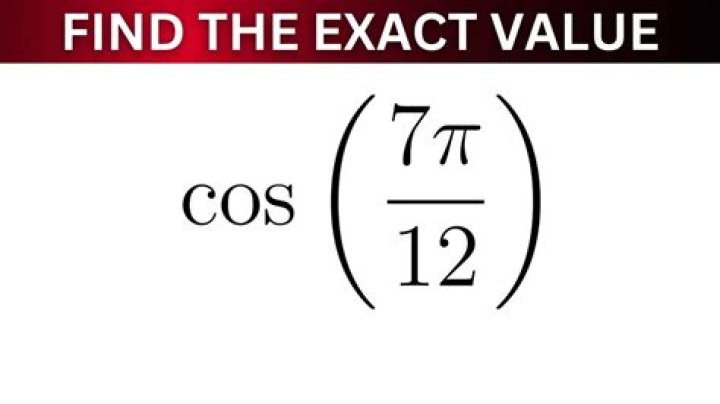
This question I look at as being similar to $\sin(7\pi/12)$. You can break it up using the special triangles into $3\pi/12 + 4\pi/12$. However with this one, I can't find one of the angles in which to use. Perhaps there is another method that I am not seeing, if someone could help me that'd be much appreciated!
$\endgroup$ 44 Answers
$\begingroup$$$\cos(a+b)=\cos(a)\cos(b)-\sin(a)\sin(b)$$$$\cos\frac{11\pi}{12}=\cos\left(\frac{3\pi}{4}+\frac{\pi}{6}\right)=\cos(3\pi/4)\cos(\pi/6)-\sin(3\pi/4)\sin(\pi/6)$$Now you can use special right triangles to find the values of those trigonometric functions.
$\endgroup$ 8 $\begingroup$More generally, for integers $a$ and $b \ne 0$, $\cos(a \pi/b)$ is one of the roots of $T_b(z) - (-1)^a$, where $T_b$ is the $b$'th Chebyshev polynomial of the first kind. Of course, so are $\cos(a' \pi/b)$ for all other integers $a'$ such that $a - a'$ is even.
In this case, $$T_{12}(z) = 2048\,{z}^{12}-6144\,{z}^{10}+6912\,{z}^{8}-3584\,{z}^{6}+840\,{z}^{4} -72\,{z}^{2}+1$$ and $T_{12}(z) + 1 $ factors as $2\, \left( 2\,{z}^{2}-1 \right) ^{2} \left( 16\,{z}^{4}-16\,{z}^{2}+1 \right) ^{2} $. Since it's not one of the roots of $2 z^2 - 1$ (i.e. $\pm 1/\sqrt{2}$, which are $\cos(\pi/4)$ and $\cos(5\pi/4)$), it's one of the roots of $16 z^4 - 16 z^2 + 1$. Those roots are $\pm \sqrt{6}/4 \pm \sqrt{2}/4$. Numerical approximation shows it must be $-\sqrt{6}/4 - \sqrt{2}/4$.
$\endgroup$ $\begingroup$I got:
$$cos(\frac{11 \pi}{12})=-\frac{1+\sqrt{3}}{2\sqrt{2}}$$
Proof the equality from above:
- Multiply numerator and denominor by:
$$\frac{1}{-1-\sqrt{3}}$$
$$\frac{1}{\frac{2\sqrt{2}}{-1-\sqrt{3}}}=-\frac{1+\sqrt{3}}{2\sqrt{2}}$$
- Than you get 1=1!
- You get:
$$\frac{2\sqrt{2}}{-1-\sqrt{3}}=\frac{2\sqrt{2}}{-1-\sqrt{3}}$$
Therefore:
$$cos(\frac{11 \pi}{12})=-\frac{1+\sqrt{3}}{2\sqrt{2}}$$
$\endgroup$ $\begingroup$Note that ${\displaystyle {11 \pi \over 12} = {1 \over 2} {11 \pi \over 6}}$, and that ${\displaystyle \cos {11 \pi \over 6} = {\sqrt{3} \over 2}} $. Hence by the half-angle formula $$\cos {11 \pi \over 12} = \pm \sqrt{ 1 + \cos {11 \pi \over 6} \over 2}$$ We take the negative sign here since ${\displaystyle {11 \pi \over 12}}$ is in the second quadrant. The above simplifies to $$= -\sqrt{ 1 + {\sqrt{3} \over 2}\over 2}$$ $$= -{\sqrt{ 2 + {\sqrt 3}} \over 2}$$ Although in a different form, this is the same as the other answers.
$\endgroup$