Find the taylor series by $f$ at $x=a$
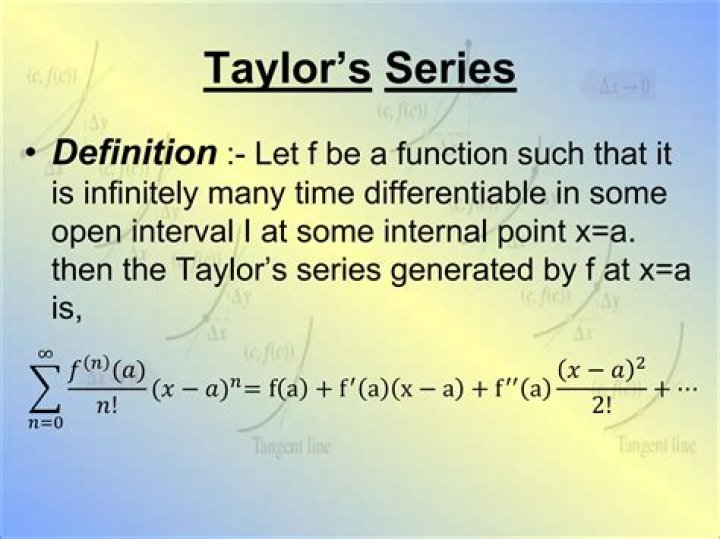
I don't know how to expand taylor series, I was wondering if anyone could guide me in the right direction, I've tried a few pages on the internet, but still cannot understand how to expand.
The example I've been given is;
Find the Taylor series generated by $f=\frac{2}{x^2}$ at $x=a$ where $a=1$
$\endgroup$2 Answers
$\begingroup$As stated by Michael, the notation $f^n(a)$ means the $n^{th}$ derivative of $f$ evaluated at $a$. A typical place to start is to list some derivatives of $f$ and evaluate them at $x=a$. For example, $f^0(a)$, the "zeroth" derivative, is just the function $f$, $f^1(a)$ is the first derivative of $f$, and so forth:
\begin{align*} f^0(a)&=\frac{2}{a^2} \\ f^1(a)&=-\frac{4}{a^3} \\ f^2(a)&=\frac{12}{a^4} \\ f^3(a)&=-\frac{48}{a^5} \\ f^4(a)&=\frac{240}{a^6} \\ \ldots &= \ldots \end{align*}
We need enough of these to spot a pattern. We assemble this all together by the formula with the sum index starting at $n=0$:
\begin{align*} &\sum_{n = 0}^{\infty} \frac{f^n (a)}{n!} (x-a)^n \\=& \frac{\frac{2}{a^2}}{0!}(x-a)^0+\frac{-\frac{4}{a^3}}{1!}(x-a)^1+\frac{\frac{12}{a^4}}{2!}(x-a)^2 +\frac{-\frac{48}{a^5}}{3!}(x-a)^3+\frac{\frac{240}{a^6}}{4!}(x-a)^4 +\ldots \\ =&\frac{2}{a^2}-\frac{4(x-a)}{a^3}+\frac{12(x-a)^2}{2a^4}-\frac{48(x-a)^3}{6a^5}+\frac{240(x-a)^4}{24a^6}-\ldots \\ =&\frac{2}{a^2}-\frac{4(x-a)}{a^3}+\frac{6(x-a)^2}{a^4}-\frac{8(x-a)^3}{a^5}+\frac{10(x-a)^4}{a^6} -\ldots+\ldots. \end{align*}
The pattern should now be clear to where most people could write the next term after visual inspection of the prior terms. The first 5 terms were more than sufficient to see it.
You can then substitute $1$ for $a$, or any other nonzero number $a$ you wish to get the Taylor series representation at that point.
$\endgroup$ $\begingroup$Find a general form for $f^n (a)$, where $f^n (x)$ is the $n$th derivative of $f(x)$. Then just plug it into the formula for the Taylor series:
$$\displaystyle \sum_{n = 0}^{\infty} \frac{f^n (a)}{n!} (x-a)^n$$
Here's the pattern: First we start with $f(x) = 2x^{-2}$. Then $f'(x) = -4x^{-3}$, $f''(x) = 12x^{-4}$, and so we see from our continued application of the power rule we find the pattern of the derivatives to be $f^n (x) = (-1)^n(2)((n+1)!) x^{-2 - n}$, so when $x = a = 1$ this is $f^n (a) = (-1)^n(2)((n+1)!)$. Thus we have
$$\displaystyle \sum_{n=0}^{\infty} (-1)^n 2(n+1) (x-1)^n$$
(You could combine the $-1$ and $x-1$ to make $(1-x)^n$ if you prefer)
$\endgroup$ 2