Galois Field GF(4)
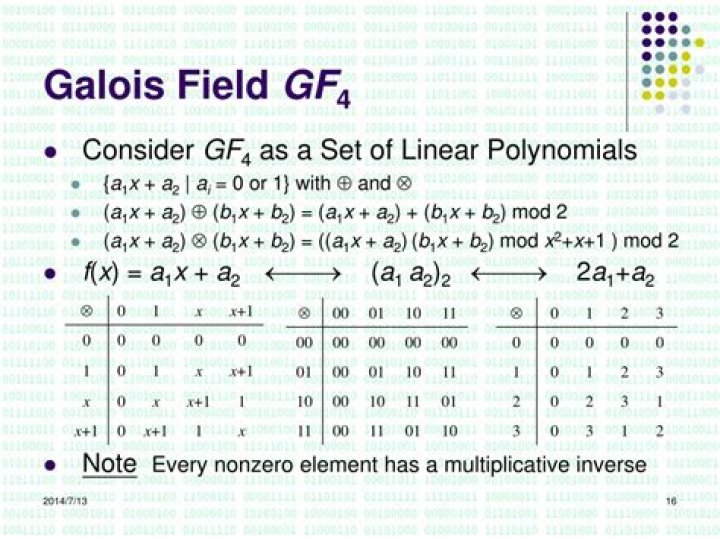
Question: Why is the table of $GF(4)$ look like the one below? I know it has to do with the fact that 4 is composite Let $GF(4) = \{0,1,B,D\}$
Addition:
$$
\begin{array}{c|cccc}
+ & 0& 1& B & D \\
\hline 0& 0 & 1 & B & D \\
1 & 1 & 0 & D & B \\
B & B & D & 0 & 1 \\
D & D & B & 1 & 0 \end{array}
$$
Multiplication:
$$\begin{array}{c|cccc}
\cdot & 0 & 1 & B & D \\
\hline
0 & 0 & 0 & 0 & 0 \\
1 & 0 & 1 & B & D \\
B & 0 & B & D & 1 \\
D & 0 & D & 1 & B \end{array}$$
2 Answers
$\begingroup$This is the only way to define operations on a four-element set making it a field (up to a permutation of elements). I will use some general properties of fields in the following.
- First, multiplication and addition are commutative, which saves us some guesswork (we only need to determine half the tables).
- Furthermore, there's got to be 0 and 1. Multiplication by 1 and 0 works the same in any field, so that takes cares of two rows in the multiplication table.
- In any field, elements distinct from zero with multiplication form an abelian group. In case of $\mathbf F_4$, it is a three-element group, and there is only one such group, so it must be the cyclic group of order three, hence $B^2=D$, $BD=1$, $D^2=B$, so we're done with multiplication.
- The characteristic of a field is always a prime number, so it must be $2$ in case of $\mathbf F_4$, so there must be zeroes on diagonal of additive table.
- Additive identity and inverse are unique, so $B+1\neq B,1,0$, so it must be $D$, similarly $D+1=B$
- Knowing the above, we can easily see that $B+D=B+B+1=0+1=1$, so we're done.
How do we construct $F_4?$ We can interpret it as a quadratic extension of $F_2$ by the roots of the polynomial $X^2 + X + 1$. If $\alpha$ denotes one root of this, then a second root is $1 + \alpha$, and from the knowledge that $1 + 1 = 0$ and $\alpha^2 = \alpha + 1$ we can work out the addition and multiplication tables of $F_4$.
$\endgroup$ 1