Gaussian curvaure of a surface revolution
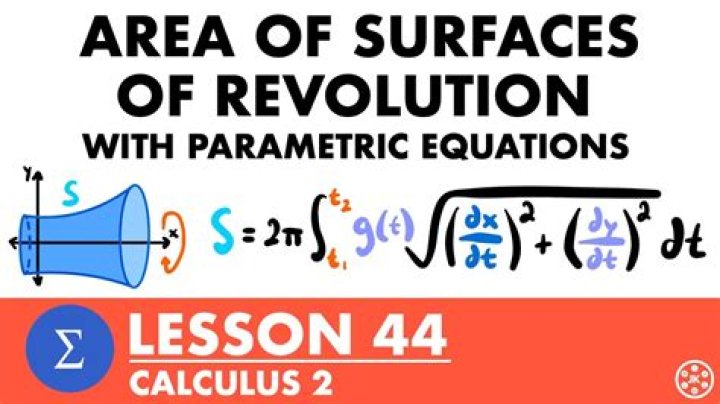
Let $\alpha(s)=(f(s), g(s))$ be a plane curve parametrized by arc length on the $yz$-plane and assume that $f(s)>0.$ The surface revolution attained by rotating the curve parameterized by $\alpha$ about the z-axis which is given by $f(u,v) = (f(u)\cos v, f(u)\sin v, g(u)).$
How do I show that it has Gaussian curvature $K(u,v) = -\frac{f''(u)}{f(u)}.$
I am wondering how it is derived? I computed the normal vector, the first and second fundamental forms but I still can't derive it.
$\endgroup$ 52 Answers
$\begingroup$$$ {\bf f}_u = (f'\cos\ v,f'\sin\ v,g'),\ {\bf f}_v = f(-\sin\ v, \cos\ v,0)$$
Note that $$N =\frac{ {\bf f}_u\times {\bf f}_v }{|{\bf f}_u\times {\bf f}_v|} =\frac{f(-g'\cos\ v, -g'\sin\ v, f')}{|{\bf f}_u\times {\bf f}_v |} $$
Since $\alpha(s)$ has unit speed, so $$(f')^2+(g')^2=1\ (A)$$ So $$N = (-g'\cos\ v, -g'\sin\ v, f').$$
Here $N_u= -(g''\cos\ v,g''\sin\ v, f''),\ N_v = (g'\sin\ v, -g'\cos\ v,0)$
Since $f'f''+g'g''=0$ from $(A)$ $(i.e.,\ g''=-\frac{f'f''}{g'})$, $$N_u = f''(f'/g'\cos\ v,f'/g'\sin\ v,1)=f''/g' {\bf f}_u$$ and $$ N_v=-g'/f {\bf f}_v$$
Hence product of eigencvalues is $f''/g' (-g'/f)=-f''/f$
$\endgroup$ 0 $\begingroup$The curves $\gamma_c(s)=f(s,c)$ ($c$ a constant) are geodesics for symmetry reasons (each of them lies in a plane s.t. the symmetry w.r.t. this plane preserves the surface). The vector field $w:=\partial/\partial v$ (in your parametrization of the surface) thus satisfies the Jacobi (=geodesic deviation) equation $w''+Rw=0$. Notice that $w=f(u)e$ where $e$ is of length 1 and orhogonal to the geodesic, hence $e'=0$. We thus have $w''+Rw=(f''+Rf)e=0$, from where $R=-f''/f$.
$\endgroup$ 0