Help with Telescopic Series with 3 terms in denominator
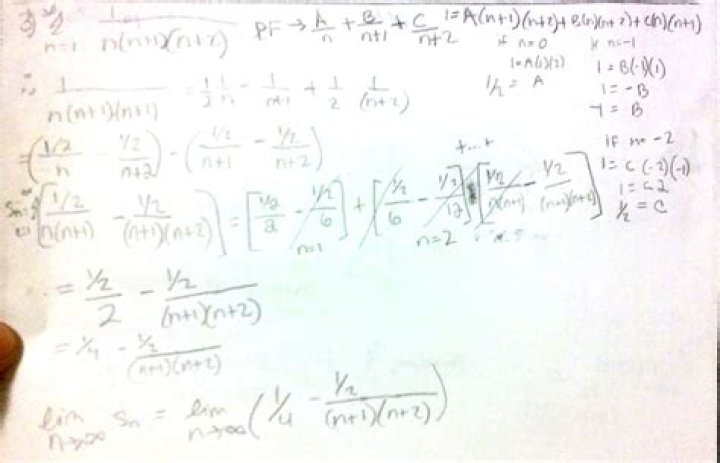
All the examples i have done and seen only have 2 terms in the denominator so I am a bit stuck with this one. I have attached what I have done so far, not sure how to proceed with it.
Thank you for the hints they were useful, after working it out more I ended up with the following but now i am confused on what to do next, do I have to do another partial fraction decomposition?My work after the hints
$\endgroup$ 42 Answers
$\begingroup$You are close to the end. Express what you got as $$\left(\frac{1/2}{n}-\frac{1/2}{n+1}\right)-\left(\frac{1/2}{n+1}-\frac{1/2}{n+2}\right).$$ It looks a little better as $$\frac{1/2}{n(n+1)}-\frac{1/2}{(n+1)(n+2)}.$$ Now add up, and (in either version) watch almost all the terms cancel.
$\endgroup$ $\begingroup$Hint:$$ \begin{align} \sum_{n=1}^\infty\frac1{n(n+1)(n+2)} &=\frac12\sum_{n=1}^\infty\left[\frac1{n(n+1)}-\frac1{(n+1)(n+2)}\right]\\ &=\frac12\sum_{n=1}^\infty\frac1{n(n+1)}-\frac12\sum_{n=2}^\infty\frac1{n(n+1)}\\ \end{align} $$More Generally$$ \begin{align} &\frac1{n(n+1)\dots(n+k-1)}-\frac1{(n+1)(n+2)\dots(n+k)}\\ &=\frac1{(n+1)(n+2)\dots(n+k-1)}\left(\frac1n-\frac1{n+k}\right)\\ &=\frac{k}{n(n+1)\dots(n+k)} \end{align} $$ Therefore, $$ \frac1{n(n+1)\dots(n+k)}=\frac1k\left[\frac1{n(n+1)\dots(n+k-1)}-\frac1{(n+1)(n+2)\dots(n+k)}\right] $$
$\endgroup$