How can I tell if a matrix is singular or nonsingular?
When solving a problem about linearly independent/dependent, I don't know what the answer means.
Question: Determine whether the collection of vectors is linearly independent in $R^3$:$(1,2,4)^T$ , $(2,1,3)^T$ , $(4,-1,1)^T$
Answer: If $$c_1(1,2,4)^T+c_2(2,1,3)^T+c_3(4,-1,1)^T=(0,0,0)^T$$
Then,$$\begin{array}{rcl} c_1+2c_2+4c_3=0\\ 2c_1+c_2-c_3=0\\ 4c_1+3c_2+c_3=0\\ \end{array}$$The coefficient matrix of the system is singular and hence the system has nontrivial solutions. Therefore the vectors are linearly dependent.
I know the method to determine whether the matrix is linearly independent or not by computing $c_1v_1+c_2v_2+...c_nv_n=0$, but here I don't know why the system is singular, so how can I tell whether it's singular or not? Are there any ways to know?
$\endgroup$ 12 Answers
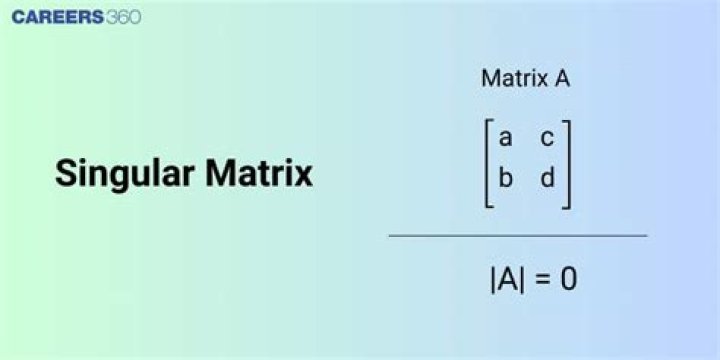
$\begingroup$If the determinant of the coefficient matrix is zero, then the matrix is singular and the system in dependent. The homogeneous system in this case has a non-zero solution as well as the trivial zero solution.
Otherwise the matrix is non-singular and the system has a unique solution which in case of homogeneous system is $(0,0,0)^T$
$\endgroup$ $\begingroup$There are many approaches that can be take (some have already been provided). One other is to apply Gaussian Elimination so that the matrix is in row echelon form (commonly denoted as $\operatorname{REF}(A)$).
If the $\operatorname{rank}\left(\operatorname{REF}(A)\right) \neq n$ then $A$ is not invertible and the system of equations is singular.
$\endgroup$