How do I cut a square in half?
I have a square that's $10\mathrm{m} \times 10\mathrm{m}$. I want to cut it in half so that I have a square with half the area. But if I cut it from top to bottom or left to right, I don't get a square, I get a rectangle!
I know the area of the small square is supposed to be $50\mathrm{m}^{2}$, so I can use my calculator to find out how long a side should be: it's $7.07106781\mathrm{m}$. But my teacher said I should be able to do this without a calculator. How am I supposed to get that number by hand?
$\endgroup$ 23 Answers
$\begingroup$Does this give you any ideas?
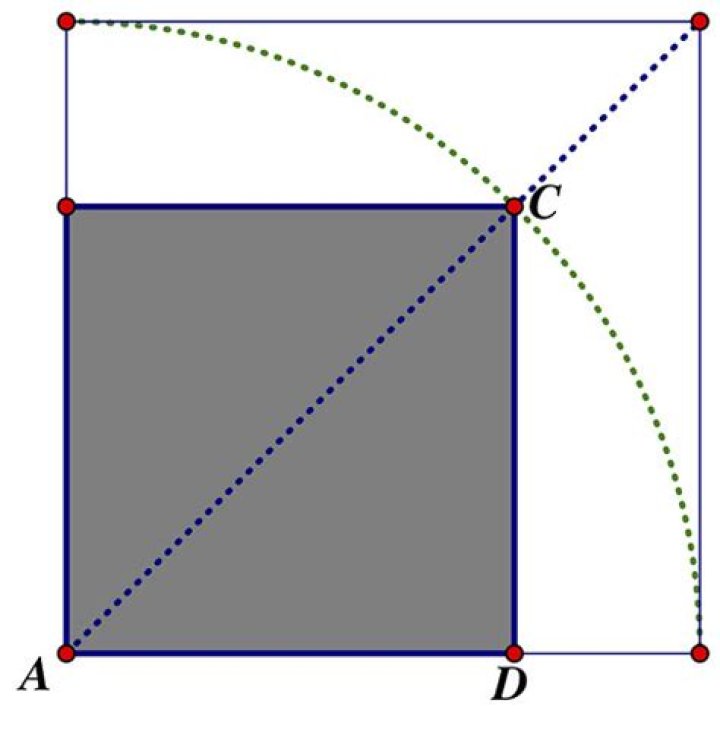
Take a pair of compasses and draw an arc between two opposite corners, centred at another corner; then draw a diagonal that bisects the arc. If you now draw two lines from the point of intersection, parallel to the sides of the square, the biggest of the resulting squares will have half the area of the original square.
Here's an illustration:
One more approach:
Consider a square of side length a. Label it A,B,C and D, counterclockwise starting from the left lower corner (A).
Draw the diagonals intersecting at M, at right angles, bisecting each other.
Pythagoras: $a^2 +a^2 = 2a^2$.
Length of diagonal = $√2 a$.
Length AM = length BM = $(1/2) √2 a$.
As mentioned before the diagonals bisect each other, and intersect perpendicularly.
These are 2 sides of the new square with half the area of the original square.
Area of reduced square : Length AM × length BM = $(1/2) a^2$.
To complete your reduced square draw a parallel to AM through B, and a parallel to BM through A.
$\endgroup$