How do I show that two sets are equal.
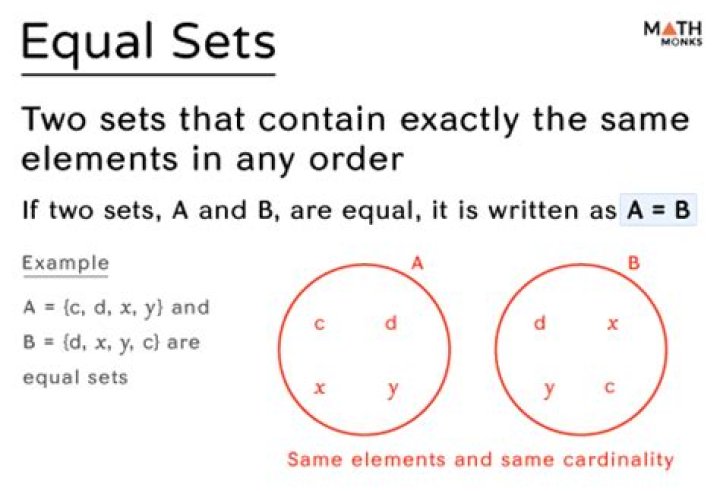
This is an ever so slightly modified version of a question from my book. My teacher went over this with me, but I would like an explanation that I can keep coming back to until I have this method figured out precisely.
$A = \{1, 2, 3, 4\}$
$B = \{ n | n \in \mathbb{Z}^+, n^2 < 17 \}$ where $\mathbb{Z}^+$ is the positive integers.
Show that $A = B$
I understand that to do this I must show for every $n$:
$n \in B \rightarrow n \in A$
and
$n \in A \rightarrow n \in B$
How to do that is still something I am not entirely sure how to do correctly, so I will give it my best and someone can show me errors or how to complete it.
If, $n \in B$ then $n^2 < 17$
$n < \sqrt{25}$, therefore $n < 5$
Since $n$ is a positive integer, $0 < n$
therefore, for every $n \in B, 0 < n < 5$, therefore $n \in A$
For every element $n$ such that $n \in A$, $n$ is one of 1, 2, 3, or 4
(I am probably taking too long to do this, but I am unsure how thorough it needs to be, so I will stop here to not waste time. What I would like to know is how can I write this quicker but still make valid statements and show that A = B more easily? I am also making statements that seem unnecessary or unconventional and perhaps even invalid from a logical perspective. I appreciate any help you can offer, the more the merrier!)
To finish the proof with help from amWhy:
$4$ is the largest element of $A$, and $4 < \sqrt{17}$
Assuming $n \in A$, $0 < n \leq 4$, $n^2 \leq 16 < 17$, therefore, $\forall n(n \in A \rightarrow n \in B)$
Therefore $A = B$, hurray!
$\endgroup$ 41 Answer
$\begingroup$Your proof strategy is fine:
To show that sets $A = B$, one usually wants to show that $A\subseteq B \text{ and}\; B \subseteq A$, which means, equivalently $$ (n \in A \rightarrow n \in B \;\text{ and}\;\; n \in A \rightarrow n \in B)$$
First part:
If, $n \in B$ then $n^2 < 17$, and $n < \sqrt{25}$, therefore $n < 5$
Replace this last statement above with:
$n^2 \lt 17$ which implies $n \lt \sqrt{17}$, therefore, $n \leq 4$.
Since $n$ is a positive integer, $0 < n,\;$ therefore, for every $\;n \in B, 0 < n < 5$.
For every element $n$ such that $n \in A$, $n$ is [one] of $1, 2, 3, \,\text{or}\; 4$
Can you proceed with the other direction? $n \in A \rightarrow n \in B\;$?
So for (II), We assume $n \in A$, $n\in \{1, 2, 3, 4\}$ and show that it follows that $n \in B$. It suffices to check that the largest element $n \in A$, $n = 4$, is such that $4^2 \lt 17$, then the square of the rest of the values in A must also be less than $17$, since $\forall n \in A, n^2 \leq 4^2 = 16 \lt 17.$ Hence, $\forall n \in A, n \in B$.
Part I and Part II show that $A = B$
$\endgroup$ 4More in general

"Zoraya ter Beek, age 29, just died by assisted suicide in the Netherlands. She was physically healthy, but psychologically depressed. It's an abomination that an entire society would actively facilitate, even encourage, someone ending their own life because they had no hope. Th…"

