How do I show this $\cos^2(\arctan(x))=\frac{1}{1+x^2}$
How do I show this?
$$\cos^2(\arctan(x))=\frac{1}{1+x^2}$$
I have absolutely no idea. Thank you.
$\endgroup$ 28 Answers
$\begingroup$$$ \tan(\arctan x) = x \\ \tan^2(\arctan x) = x^2\\ 1+\tan^2(\arctan x) = 1+x^2\\ \sec^2(\arctan x) = 1+x^2 \\ \cos^2(\arctan x) = \frac1{1+x^2} $$
$\endgroup$ $\begingroup$Note: David Holdens way is a very clean way to go, just using algebra and trig rules. The approach below is rather handy though for remembering the derivations.
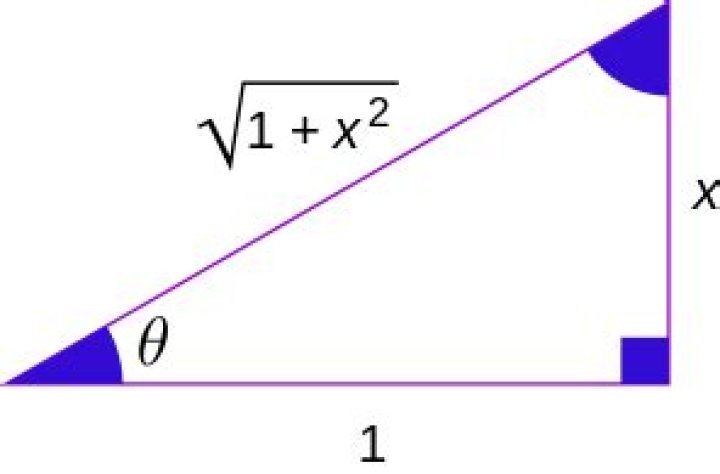
Start by drawing a right angled triangle where the tan of the angle is $x$. Use pythagoras theorem to get the final side as so:
This comes from the wikipedia page on inverse trig functions, which you can see for yourself. It's quite handy as it has the diagrams you might need and the relations trig composed with inverse trig functions.
Now notice that from soh-cah-toa or whichever trig mnemonic you use that $\tan(\theta)=x/1=x\,$ (o/a) so $\theta=\arctan(x)$ thus
$$\cos(\theta)=\cos(\arctan(x))=\frac{1}{\sqrt{1+x^2}}\quad(a/h)$$
Thus $$\cos^2(\arctan(x))=\frac{1}{1+x^2}$$
$\endgroup$ $\begingroup$Proof: \begin{align} \cos^2(\arctan{x}) & = \frac{1}{\frac{1}{\cos^2(\arctan{x})}} \\ & = \frac{1}{\frac{\cos^2(\arctan{x}) + \sin^2(\arctan{x})}{\cos^2(\arctan{x})}} \\ & = \frac{1}{{1+\tan^2(\arctan{x})}} \\ & = \frac{1}{1+x^2} \end{align}
$\endgroup$ $\begingroup$Let's recall the following identities;
\begin{align} \cos\theta &= \frac{e^{i\theta}+e^{-i\theta}}{2}\ \ \ \ \ \ \ \ \ \ \ \ \ \ (1)\\ \arctan\theta &= \frac{i}{2}\ln\left(\frac{i+\theta}{i-\theta}\right) \ \ \ \ \ \ \ \ \ \ (2)\\ \end{align}
where $i^2 = -1$. Now it's just a case of "plug-and-play". Firstly, we square $(1);$
\begin{align} \cos^2{\theta} &= \frac{1}{4}(e^{i\theta}+e^{-i\theta})^2\\ &= \frac{e^{2i\theta} + 2 + e^{-2i\theta}}{4}. \end{align}
Now, we let $\theta = \arctan{\varphi} = \frac{1}{2}\ln\left(\frac{i+\varphi}{i-\varphi}\right)$, and simplify;
\begin{align} \cos^2{(\arctan{\varphi})} &= \frac{e^{2i\left[\frac{i}{2}\ln\left(\frac{i+\varphi}{i-\varphi}\right)\right]} + 2 + e^{-2i\left[\frac{i}{2}\ln\left(\frac{i+\varphi}{i-\varphi}\right)\right]}}{4}\\ &= \frac{1}{4}\left(\frac{i-\varphi}{i+\varphi} + 2 + \frac{i+\varphi}{i-\varphi}\right)\\ &= \frac{1}{4}\left(\frac{(i-\varphi)^2 + (i+\varphi)^2}{i^2 - \varphi^2} + 2\right)\\ &= \frac{1}{2}\left(\frac{1 - \varphi^2}{1 + \varphi^2} + 1\right)\\ &= \frac{1}{2}\left(\frac{1-\varphi^2 + 1 + \varphi^2}{1+\varphi^2}\right)\\ &= \frac{1}{1+\varphi^2} \end{align}
as desired.
Throughout, we note that $\varphi \neq \pm i$. A fun algebraic exercise!
$\endgroup$ 0 $\begingroup$Try substituting $arctan(x)$ = $y$.
Also, there is an identity $cos^2(\theta) + sin^2(\theta) = 1$
$\endgroup$ $\begingroup$I'd give $\arctan x$ a name, call it $\theta$. Then we can say $\tan\theta=x$; our goal is now to find $\cos\theta$.
One way to proceed is this: $\sec^2\theta = \tan^2\theta + 1 = x^2 + 1$. Thus, $\sec\theta$ is the square root of that, and its reciprocal will be $\cos\theta.$
$\endgroup$ $\begingroup$Let $\theta$ be one of the angle measures of a triangle with $\tan\theta = x$, so that $\arctan x = \theta$. By drawing the triangle we see that the opposite side has length $x$, adjecent 1, and hypotenuse $\sqrt{1+x^2}$ (all up to a scalar factor). Now compute $\cos^2(\theta)$.
$\endgroup$ $\begingroup$Following on Trevor's comment. Transform Y=Y(t) into a parametric equation. Then apply trigonometry and calculus to get the solution.
In the simplest case Y = t^2, the parametric equation is
$$t= x$$ $$y= x^2$$
Using the trigonometry definition of $Tan\theta$ = Opposite side/Related side; (Very important definition Opposite side/Related side); then, $$Tan(\theta) = x$$ and$$\theta = Atan(x)$$ Taking the derivative of $Tan(\theta)$ we find that $$\frac{1}{cos^2{\theta}}\frac{d\theta}{dx}=1$$Substituting $\theta$
$$\frac{1}{cos^2{(Atan(x))}}\frac{d(Atan(x))}{dx}=1$$; thus,
$$\frac{d(Atan(x))}{dx}={cos^2{(Atan(x))}}$$.
Hence,
$$\frac{1}{1+x^2}=cos^2(\arctan(x))$$
If the approach works; let $Y = t^7$
$$t= x$$ $$y= x^7$$
Then $$Tan(\theta) = x^6$$ $$\theta = Atan(x^6)$$ so
$$\frac{1}{cos^2{(Atan(x^6))}}\frac{d(Atan(x^6))}{dx}=6x^5$$ $$\frac{d(Atan(x^6))}{dx}=6x^5({cos^2{(Atan(x^6))}})$$ $$\frac{6x^5}{1+x^{12}}=(6x^5)cos^2(\arctan(x^6))$$ $$\frac{1}{1+x^{12}}=cos^2(\arctan(x^6))$$
But the result is just the substitution $x->x^6$. What is important is the use of parametrisation. More can be seen using rotations of a parmetrized equation. -ER
$\endgroup$