How many outcomes are there when you roll 4 dice?
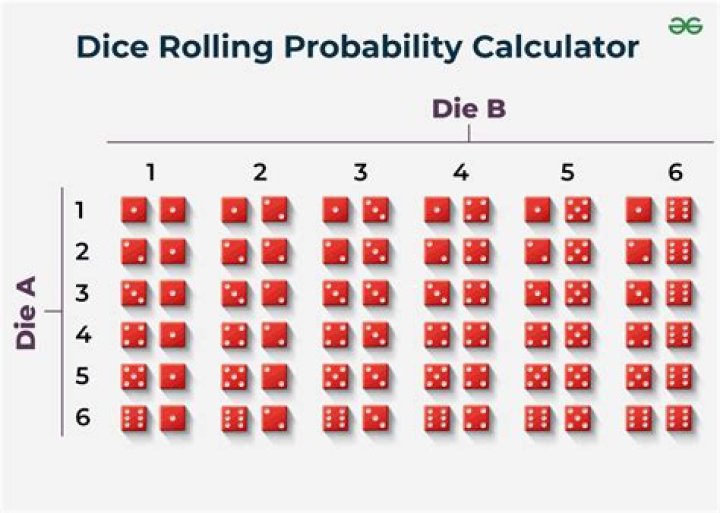
My initial reaction is to say that the answer is $6^4$, since 4 dice can have 6 outcomes. In my train of thought, the first dice can have 6 outcomes, same as the second, third and fourth, thus $6*6*6*6$ would seem fitting. However, my professor claims that answer is wrong because it overcounts, and says that the answer is actually $9 \choose 4$.
Can someone help me understand how it overcounts and why the answer is $9 \choose 4$?
$\endgroup$ 42 Answers
$\begingroup$Your answer of $6^4$ would be correct if we were considering ordered outcomes, where it matters what each die shows in order. In this scenario, you'd treat $1,1,1,2$ as different from $1,2,1,1$ for instance.
Your professor is considering unordered outcomes, which would treat both of the examples above as $3$ ones plus $1$ two.
One way to count the unordered outcomes is a stars and bars approach - Wikipedia. Here you imagine your 4 dice as 'stars' and your $6$ individual outcomes (numbers $1\dots6$) as $5$ 'bars'. An outcome looks something like: $$\text{ones}\left|\vphantom\int\right. \text{twos}\left|\vphantom\int\right. \text{threes}\left|\vphantom\int\right. \text{fours}\left|\vphantom\int\right. \text{fives}\left|\vphantom\int\right. \text{sixes}$$
The combination $1,2,1,1$ (3 ones, 1 two) would look like: $$***\left|\vphantom\int\right. *\left|\vphantom\int\right. \left|\vphantom\int\right. \left|\vphantom\int\right. \left|\vphantom\int\right. $$
The combination $2,4,4,5$ (1 two, 2 fours, 1 five) would look like: $$\left|\vphantom\int\right. *\left|\vphantom\int\right. \left|\vphantom\int\right. **\left|\vphantom\int\right. *\left|\vphantom\int\right. $$
All together there are 9 objects (4 stars, 5 bars), and any combination amounts to picking 5 of the locations for the bars - $\dbinom95$ possibilities, or picking 4 locations for the stars - $\dbinom94$ possibilities. Happily, they give the same result.
$\endgroup$ $\begingroup$I think the answer of @Frentos should be accepted. Here I will just give an alternative.
- Suppose all $4$ dice are different, then you have $6\choose 4$ possibilities.
- Suppose $2$ dice are the same and the other two different, then you have $6\cdot{ 5\choose 3}$ possibilities.
- Suppose $3$ dice are the same, the you have $6\cdot 5$ possibilities.
- Suppose all dice are the same, then you have $6$ possibilities.
- Suppose there are two numbers appearing two times each, then you have $6\cdot5$ possibilities.
Summing up the numbers above gives $9\choose 4$.
Obviously, this approach is very time consuming when dealing with a bigger amount of dice.
$\endgroup$More in general

"Zoraya ter Beek, age 29, just died by assisted suicide in the Netherlands. She was physically healthy, but psychologically depressed. It's an abomination that an entire society would actively facilitate, even encourage, someone ending their own life because they had no hope. Th…"

