How to calculate the variance of a portfolio?
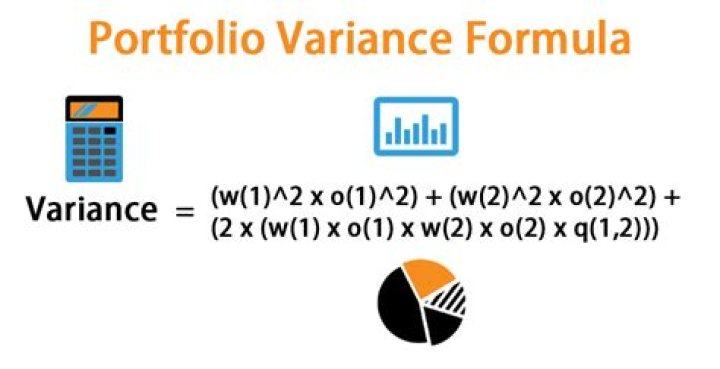
So I have this question :
Florida Company (FC) and Minnesota Company (MC) are both service companies. Their stock returns for the past three years were as follows: FC: -5 percent, 15 percent, 20 percent; MC: 8 percent, 8 percent, 20 percent.
And I calculate :
Mean return FC=10%, mean return of MC=12%.
Var(FC) = [( -5 - 10)^2 + (15 - 10)^2 + (20 - 10)^2]/3 = 116.67.
Var(MC) = [(8 - 12)^2 + (8 - 12)^2 + (20 - 12)^2]/3 = 32
Standard deviation (FC) = 116.7^0.5 = 10.8%. Standard deviation (MC) = 32^0.5 = 5.7%.
Covariance= : [(-5 - 10)(8 - 12) + (15 - 10)(8 - 12) + (20 - 10)(20 - 12)]/3 = 40.
Correlation coefficient = covariance/[(S.D.(FC)) × (S.D.(MC))] = 40/(10.8 × 5.7) = +0.655.
Now, if FC and MC are combined into a portfolio with 50 percent of the funds invested in each stock, then
Return on portfolio=Rp = (10)(0.5) + (12)(0.5) = 11%.
and finally the variance.
On the answer sheet it states that the variance of this portfolio is:
Var(P) = (0.5^2)(116.7) + (0.5^2)(32) + (2)(0.5)(0.5)(40) = 57.17.
The thing is that I do not see the standard deviations as being part of the formula (at the end).
I thought that the Var(P) was
then,
(0.5^2)(116.7) + (0.5^2)(32) + (2)(0.5)(0.5)(0.108)(0.057)(40)
where the SD's are the ones that we calculated before the portfolio was taken into consideration.
Why is it so that on the answer sheet the variance does not include the old standard deviations? Why is there a mutation of the original formula?
Please explain in the simplest way possible... thanks!
$\endgroup$ 41 Answer
$\begingroup$The answer is correct because covariance already incorporates standard deviations.
$$2\cdot 0.5 \cdot 0.5 \cdot 0.655\cdot 10.8 \cdot 5.7 = 2 w_1w_2\rho_{12}\sigma_1\sigma_2 = 2w_1w_2cov(R_1,R_2) = 2 \cdot 0.5 \cdot0.5\cdot 40\\ = 20 $$
$\endgroup$