How to identify an orthogonal(orthonormal matrix)?
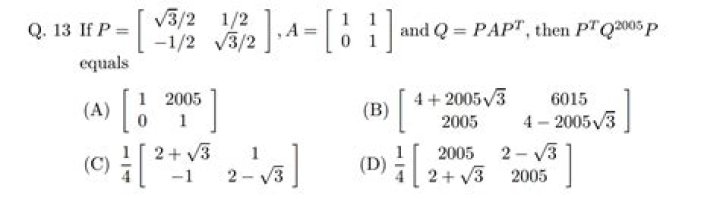
This question was asked in an examination a while back.
I was able to solve this question but the computation required was too much. The solution said that the trick to solving this lies in the fact that the product of $P$ with its Transpose is an Identity matrix.(I've come to learn that this is known as an orthogonal matrix).
My question is, how can I know something like this while solving the question. Given any Matrix $A$ , is it possible to identify whether it is an orthogonal matrix?
PS:I am still in high school, so please use simple words to explain.
Thank you.
2 Answers
$\begingroup$Identifying an orthogonal matrix is fairly easy: a matrix is orthogonal if and only if its columns (or equivalently, rows) form an orthonormal basis. A set of vectors $\{v_1, \ldots, v_n\}$ is said to be an orthonormal basis if $v_i \cdot v_i = 1$ for all $i$ and $v_i \cdot v_j = 0$ for all $i \neq j$.
(If you want to see why this is true, think about what it means to say that $P^TP = I$ in terms of the columns of $P$.)
We can check this for the matrix $P$ you gave: $$P = \begin{pmatrix} \sqrt{3}/2 & 1/2 \\ -1/2 & \sqrt{3}/2 \end{pmatrix}$$ We have two columns: $$e_1 = {\sqrt{3}/2 \choose -1/2} \quad e_2 = {1/2 \choose \sqrt{3}/2}$$ with $e_1 \cdot e_1 = 3/4 + 1/4 = 1$, $e_2 \cdot e_2 = 1$ and $e_1 \cdot e_2 = \sqrt{3}/4 - \sqrt{3}/4 = 0$, so $P$ is indeed orthogonal.
Of course, another way of checking is just to multiply $P^T$ by $P$ and see if you get $I$!
In the context of the question, how would you go about solving it? If you write out in full what it's asking you to do, you see it's asking you to compute $P^T(PAP^T)^{2005}P$, which is a bit terrifying. But it's hoping that you'll notice that if you start expanding this out you get $P^TPAP^TPAP^TPA\ldots P^TP$.
It's normally reasonable to assume that the people who set exams aren't completely evil, and that they expect you to solve the question, and that multiplying out all these matrices is an unreasonable expectation in the time you're given. So we notice that $P^TPA$ occurs again and again, and we might hope that it's something nice.
When you multiply $P^TPA$ out, you get $A$ itself back! (Because $P$ is orthogonal, as we just showed.) So the question reduces to calculating $A^{2005}$. This still seems a little unreasonable to do directly, so we are missing another trick. If we start working out $A, A^2, A^3, \ldots$ we notice that $$A^n = \begin{pmatrix} 1 & n \\ 0 & 1 \end{pmatrix}$$ This is straightforward to prove using induction, but from the looks of the question it's just a multiple choice so don't need to.
$\endgroup$ 2 $\begingroup$Notice that $P$ is in the form of a rotation matrix. That is, $P$ has entries of the form
$$ P = \begin{bmatrix} \sqrt{3}/2 & 1/2 \\-1/2 & \sqrt3/2 \end{bmatrix} = \begin{bmatrix} \sin(60^\circ) & \cos(60^\circ) \\ -\cos(60^\circ) & \sin(60^\circ) \end{bmatrix} $$
This is known to be an orthogonal matrix. That's because orthogonal matrix are exactly those matrices that preserve distances in that space (I can show you the proof if you want), and rotation preserve distances in $\mathbb{R}^2$.
There's no surefire way to find out if a matrix is orthogonal. However, another way to characterize orthogonal matrices is to see that if you think of the matrix as vectors along columns,
$$P = \begin{bmatrix} \sin(60^\circ) \\ -\cos(60^\circ) \end{bmatrix} : \begin{bmatrix} \cos(60^\circ) \\ \sin(60^\circ) \end{bmatrix} $$
Consider the columns as vectors:
$$ v_1 = (\sin 60^\circ, -\cos 60^\circ) \\ v_2 = (\cos 60^\circ, \sin 60^\circ) $$
Now, notice that the matrix decomposed as vectors has orthonormal vectors - that is, the vectors have length 1 (you can check this by taking the dot product with itself). However, the dot product with any other vector is $0$.
I've done some partial computation here. You can check it for the other vectors as well$$v1 \cdot v1 = \sin^2 60^\circ + \cos^2 60^\circ = 1 \\ v1 \cdot v2 = \sin 60^\circ \cdot \cos 60^\circ - \cos 60^\circ \cdot \sin 60^\circ = 0$$
This is another way to characterize an orthogonal matrix - the matrix whose columns are pairwise orthogonal. This acts as a quick test to check if the matrix is orthogonal or not.
$\endgroup$ 12