How to make use of angle sum and difference identities to find the value of sine and cosine?
Calculate: $\cos\left({5\pi\over12}\right)$ and $\cos\left({\pi\over12}\right)$
What is the easiest way to find $\cos\left({5\pi\over12}\right)$ and $\cos\left({\pi\over12}\right)$ (without a calculator)? If I know that $\frac{5\pi }{12}=\frac{\pi }{4}+\frac{\pi }{6}$ and $\frac{\pi }{12}=\frac{\pi }{3}-\frac{\pi }{4}$, then I can apply angle sum and difference identities. But how do I know $\frac{5\pi }{12}= \frac{\pi }{4}+\frac{\pi }{6}$ and $\frac{\pi }{12}= \frac{\pi }{3}-\frac{\pi }{4}$ in the first place. I know $ \frac{\pi }{4}+\frac{\pi }{6} = \frac{5\pi }{12}$ and $ \frac{\pi }{3}-\frac{\pi }{4}=\frac{\pi }{12}$ but I can't go the other way round.
I gave $\frac{5\pi}{12}$ and $\frac{\pi}{12}$ as an example, I want the general solution for any value in pi rational form $\frac{\pi p}{q}$.
$\endgroup$ 44 Answers
$\begingroup$We want to find the values of $\displaystyle\cos\frac{5\pi}{12}$ and $\displaystyle\cos\frac{\pi}{12}$.
Recall the sum to product formulae below:$$\begin{align}\cos A+\cos B&=2\cos\frac{A+B}{2}\cos\frac{A-B}{2}\\ \cos A-\cos B&=-2\sin\frac{A+B}{2}\sin\frac{A-B}{2}\\\end{align}.$$In our case, let $A=5\pi/12$ and $B=\pi/12$. Then we find that$$\begin{align}\cos\frac{5\pi}{12}+\cos\frac{\pi}{12}&=2\cos\frac{\frac{5\pi}{12}+\frac{\pi}{12}}{2}\cos\frac{\frac{5\pi}{12}-\frac{\pi}{12}}{2}=2\cos\frac{\pi}{4}\cos\frac{\pi}{6}\\ &=\frac{\sqrt6}{2}\tag{1}\\ \cos\frac{5\pi}{12}-\cos\frac{\pi}{12}&=-2\sin\frac{\frac{5\pi}{12}+\frac{\pi}{12}}{2}\sin\frac{\frac{5\pi}{12}-\frac{\pi}{12}}{2}=-2\sin\frac{\pi}{4}\sin\frac{\pi}{6}\\ &=-\frac{\sqrt2}{2}\tag{2}.\end{align}$$Adding equations $(1)$ and $(2)$ together and dividing by $2$, we find that$$\cos\frac{5\pi}{12}=\frac{\sqrt6-\sqrt2}{4}$$and subtracting equation $(2)$ from equation $(1)$ and dividing by $2$ gives$$\cos\frac{\pi}{12}=\frac{\sqrt6+\sqrt2}{4}.$$
However, this method is not always guaranteed to work, for the simple reason that $\cos x\pi$ does not always have a closed form for rational $x$.
I hope that helps. If you have any questions please don't hesitate to ask :)
$\endgroup$ $\begingroup$1 equation and 2 unknows is, generally, an overdetermined system.
In this case, pick any solution for $\dfrac{5\pi}{12} = \dfrac{p_1\pi}{q_1} + \dfrac{p_2\pi}{q_2}$, and sum $\pm \dfrac{p_3\pi}{q_3}$ in a smart way
$$\dfrac{5\pi}{12} = \left( \dfrac{p_1\pi}{q_1} + \dfrac{p_3\pi}{q_3} \right) + \left( \dfrac{p_2\pi}{q_2} - \dfrac{p_3\pi}{q_3} \right)$$
$$\dfrac{5\pi}{12} = \dfrac{\pi}{6} + \dfrac{\pi}{4} = \dfrac{\pi}{3} + \dfrac{\pi}{12} = \dfrac{3\pi}{10} + \dfrac{7\pi}{60} = \dots $$
$\endgroup$ $\begingroup$We know that
$$\begin{align} \cos{\pi\over 4}&=\sin{\pi\over 4}={\sqrt{2}\over 2}\\ \cos{\pi\over 6}&=\sin{\pi\over 3}={\sqrt{3}\over 2}\\ \cos{\pi\over 3}&=\sin{\pi\over 6}={1\over 2}\\ \cos(x+y)&=\cos{x}\cos{y}-\sin{x}\sin{y}\\ \cos(x-y)&=\cos{x}\cos{y}+\sin{x}\sin{y}\\ \sin(x+y)&=\sin{x}\cos{y}+\cos{x}\sin{y}\\ \cos(x-y)&=\sin{x}\cos{y}-\cos{x}\sin{y}\\ \end{align}$$
With the above you should be done.
$\endgroup$ 0 $\begingroup$After practicing a lot of problems in trigonometry, I realized that I need to know the values of sine and cosine only at $\{ \pi/6, \pi/4, \pi/3\}$, and the double angle, half angle and sum and difference identities. @marwalix et al. answered the same.
By applying the double angle formula (i.e. $\sin \left( 2\theta \right) =2\sin \theta \cos \theta$), I found the value of $\{\pi/5, 2\pi/5\}$:
$$\dfrac{\pi }{5}=2\cdot \dfrac{\pi }{10}$$$$\dfrac{2\pi }{5}=2\cdot \dfrac{\pi }{5}$$
By applying the half angle formula (i.e. $\sin \dfrac{\theta }{2}=\sqrt{\dfrac{1-\cos \theta }{2}}$, $\cos \dfrac{\theta }{2}=\sqrt{\dfrac{1+\cos \theta }{2}}$), I found the value of $\{ \pi/12, \pi/8\}$:
$$\dfrac{\pi }{12}=\dfrac{1}{2}\cdot \dfrac{\pi }{6}$$$$\dfrac{\pi }{8}=\dfrac{1}{2}\cdot \dfrac{\pi }{4}$$
And finally, by applying $\sin(\alpha \pm \beta) = \sin \alpha \cos \beta \pm \cos \alpha \sin \beta$, and $\cos(\alpha \pm \beta) = \cos \alpha \cos \beta \mp \sin \alpha \sin \beta$, I found the value of $\{ \pi/12, 3\pi/10, 3\pi/8, 5\pi/12\}$:
$$\dfrac{\pi }{12}=\dfrac{\pi }{3}-\dfrac{\pi }{4}=\dfrac{\pi }{4}-\dfrac{\pi }{6}$$$$\dfrac{3\pi }{10}= \dfrac{\pi }{10}+\dfrac{\pi }{5}=\dfrac{2\pi }{5}-\dfrac{\pi }{10}$$$$\dfrac{3\pi }{8}=\dfrac{\pi }{4}+\dfrac{\pi }{8}, \dfrac{5\pi }{12}=\dfrac{\pi }{4}+\dfrac{\pi }{6}$$
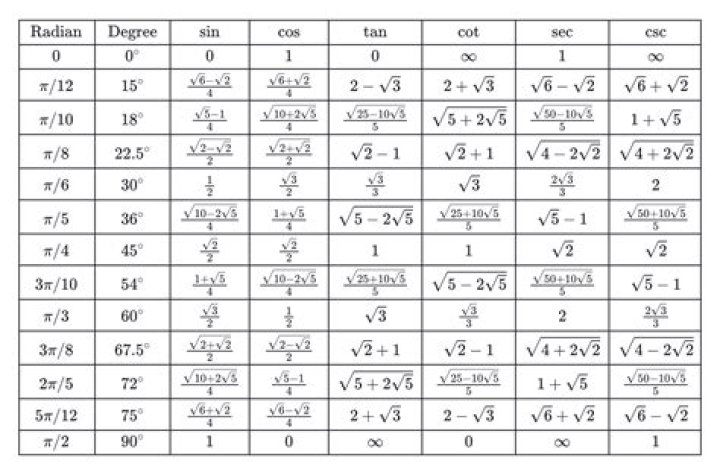
The values that I found at $\{0, \pi/12, \pi/10, \pi/6, \pi/5, \pi/4, 3\pi/10, \pi/3, 3\pi/8, 2\pi/5, 5\pi/12, \pi/10\}$ are as follows:
More in general

"Zoraya ter Beek, age 29, just died by assisted suicide in the Netherlands. She was physically healthy, but psychologically depressed. It's an abomination that an entire society would actively facilitate, even encourage, someone ending their own life because they had no hope. Th…"

