Identifying Independent And Dependent Variables In Differential Equations
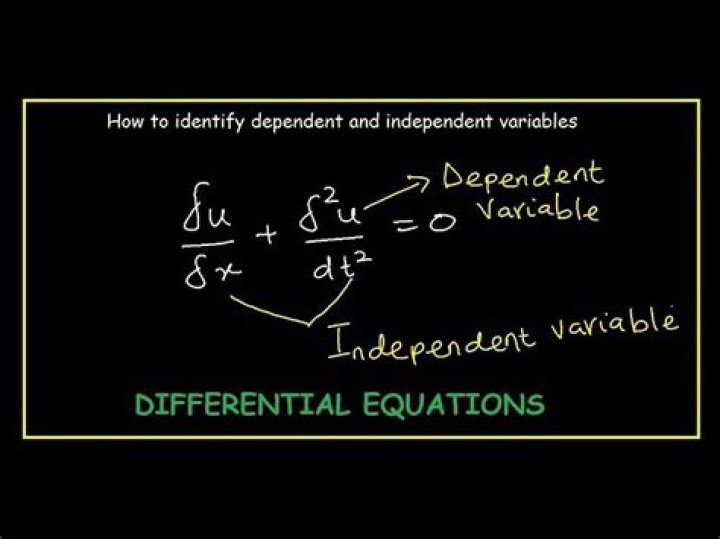
I've been given a second order differential equation $$x^2y'' + xy' + (x^2 - v^2)v = 0$$(where $v$ is a parameter)* and asked to identify the dependent and independent variables. Question is How do i know which are dependent and independent? I'am only used to equations of the form $x^2\frac{d^2y}{dx^2} + \frac{dy}{dx} = 0$ where i can easily tell that $y = f(x)$.
*I don't know what that means!
Thanks In Advance.
$\endgroup$ 62 Answers
$\begingroup$Usually when you see the $y'$ derivative notation in this context it just means the derivate of $y$ wrt $x$, i.e. $\frac{dy}{dx}$. So $$x^2y\prime\prime + xy\prime + (x^2 - v^2)v \equiv x^2\frac{d^2y}{dx^2} + x\frac{dy}{dx} + (x^2 - v^2)v$$ and $y(x)$ would be the dependent variable.
$\endgroup$ 1 $\begingroup$Here, $y$ is a dependent variable of the independent variable $x$. Now Mark Beadles already answered that part, the part I'm going to answer is the "*I don't know what that means" part. The notion of parameter here means that for each value of $\nu$, we are given the differential equation. Solving this equation for $y$ as a function of $x$ and $\nu$ does not mean that $y$ is a function of $\nu$, but rather that given $\nu$, $y(x)$ solve the differential equation with $\nu$ fixed. For instance, the well-known equation $$ \frac{dy}{dx} = \lambda x, $$ where $\lambda$ is a parameter, has the solution $y(x) = Ce^{\lambda x}$, with $C$ a real constant. The fact that $\lambda$ is in the expression of $y$ does not mean that $y$ is a function of $\lambda$ ; when you consider the differential equation, you fix $\lambda$ beforehand, and then you solve the differential equation to find $y(x)$. In other words, you're not solving for $y(x,\lambda)$, but you're finding $y(x)$ for a family of differential equations parametrized by the parameter $\lambda$.
Hope that helps,
$\endgroup$ 1