Infinite network of resistors
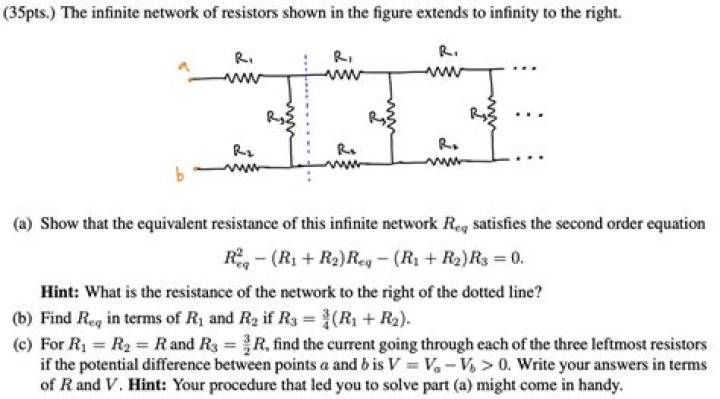
In Physic, I have to find a way to prove, with equations, that the sum of an infinite network of resistors of 1 $\Omega$ has a limit value. This question is based on the resistor's rules:
In a parallel circuit: $R_E = (R_1^{-1}+R_2^{-1}...)^{-1}$
In a series circuit: $R_E = R_1+R_2...$
Here is my scheme: Click to see the image!
I begin my mathematical reasoning by using Excel to calculate the most precise value. I discovered that Excel does not compute more that 15 digits... but I still got an overview of the possible answer: 2.73205080756888. I also understood the principle of adding the previous number calculated and just add the new loop to the answer, but my teacher told me that using series was difficult...
So, I decided to search online to find a solution and I found that: $$R_{eq} = R \cdot (1+\sqrt{3})$$, but it don't understand how to get up to there. They added a short reasoning: Click to see.
Does anyone could add more steps in the reasoning or give me a hint to use series in this particular case?
Edits
In my excel file, I found that my function to compile the value was : $$(\text{ANS}^{-1}+1)^{-1}+2$$ Where ANS is the result of the calculation of the third or more loop
based on the third loop. The result of my first loop is 3 (sum of the three resistors in serie), the sum of my second loop is calculated based on: $$({3}^{-1}+1)^{-1}+2$$, then you realize when calculating that you are adding the previous numbers, so I have used the previous cell number (ANS)
$\endgroup$ 03 Answers
$\begingroup$Notice that in your ladder
the leftmost three resistors can be removed and it is the same ladder again. Therefore, we have
$$ R_{eq} = R + R + R \parallel R_{eq} $$ where $R \parallel T$ means $(R^{-1} + T^{-1})^{-1}$.
$\endgroup$ 2 $\begingroup$$$R_E=R+R||R_E+R=2R+\frac{RR_E}{R+R_E}$$ Solve it for $R_E$
The reason is when you look through the ladder network (from the arrow in the picture), what you see in the second stage (just behind the $R$ opposite the arrow) is again $R_E$ (since the ladder is infinite) which is parallel to an $R$ and there are two $R$ in series (the two sides of the arrow).
$\endgroup$ 7 $\begingroup$- Three series resistors: $$\text{R}_1=\text{R}+\text{R}+\text{R}=3\text{R}$$
- Three series resistors, parallel to the second, first resistor: $$\text{R}_2=\frac{\left(\text{R}+\text{R}+\text{R}\right)\cdot\text{R}}{\text{R}+\text{R}+\text{R}+\text{R}}+\text{R}+\text{R}=\frac{\text{R}_1\cdot\text{R}}{\text{R}_1+\text{R}}+2\text{R}=\frac{11}{4}\cdot\text{R}$$
- Three series resistors, parallel to the second, second resistor: $$\text{R}_3=\frac{\left\{\frac{\left(\text{R}+\text{R}+\text{R}\right)\cdot\text{R}}{\text{R}+\text{R}+\text{R}+\text{R}}+\text{R}+\text{R}\right\}\cdot\text{R}}{\frac{\left(\text{R}+\text{R}+\text{R}\right)\cdot\text{R}}{\text{R}+\text{R}+\text{R}+\text{R}}+\text{R}+\text{R}+\text{R}}+\text{R}+\text{R}=\frac{\text{R}_2\cdot\text{R}}{\text{R}_2+\text{R}}+2\text{R}=\frac{51}{15}\cdot\text{R}$$
And so on. So the next one will be:
$$\text{R}_4=\frac{\text{R}_3\cdot\text{R}}{\text{R}_3+\text{R}}+2\text{R}=\frac{153}{56}\cdot\text{R}$$
And the next one:
$$\text{R}_5=\frac{\text{R}_4\cdot\text{R}}{\text{R}_4+\text{R}}+2\text{R}=\frac{571}{209}\cdot\text{R}$$
So, in general:
$$\color{red}{\text{R}_{1+\text{n}}=\frac{\text{R}_\text{n}\cdot\text{R}}{\text{R}_\text{n}+\text{R}}+2\text{R}}$$
In other words:
$$\text{R}_{\text{eq}}=\frac{\text{R}_{\text{eq}}\cdot\text{R}}{\text{R}_{\text{eq}}+\text{R}}+\text{R}+\text{R}\Longleftrightarrow\text{R}_{\text{eq}}=\text{R}\cdot\left(1\pm\sqrt{3}\right)$$
$\endgroup$ 1