injective curve inside curve
I am struggling to prove the following intuitive result:
Take $\phi:[a,b]\rightarrow \mathbb{R}^{n}$ a continuous mapping with $\phi(a)\neq\phi(b)$. Then there is a continuous injective mapping $\phi_{0}$ with image contained in $\phi([a,b])$ such as $\phi_{0}(a)=\phi(a)$ and $\phi_{0}(b)=\phi(b)$.
I found this statement in Falconer, The geometry of fractal sets, with a sadly incorrect proof, which went as follows.
"Take the collection $\mathcal{C}$ of proper intervals $I_{x}$ of the form $[t_{1},t_{2}]$ with $\phi(t_{1})=\phi(t_{2})=x$ who are contained in no other intervals of the same form. Since it is a collection of countably many proper disjoint closed intervals, we can find a continuous surjective increasing function $f:[a,b]\rightarrow [a,b]$ such as $f(t_{1})=f(t_{2})$ if and only if $t_{1}=t_{2}$ or if $t_{1},t_{2}$ are in a same interval of $\mathcal{C}$. Then it is easy to check that $\phi_{0}$, defined by $\phi_{0}(u)=x$ if $f^{-1}(u)=I_{x}$ and $\phi_{0}(u)=\phi(f^{-1}(u))$ otherwise, satisfies our requirements."
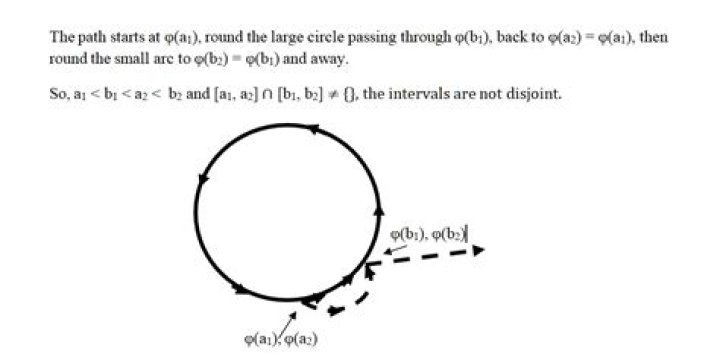
The problem with that proof is that though the intervals of $\mathcal{C}$ are indeed proper and closed, they are not necesarily disjoint. I can't reproduce the drawing here but it is not too difficult to show a curve in $\mathbb{R}^{2}$ with two double points $x,y$ such as $\phi(a_{1})=\phi(a_{2})=x$, $\phi(b_{1})=\phi(b_{2})=y$, and $a_{1} < b_{1} < a_{2} < b_{2}$.
I don't know how to complete the proof (I even tried with Zorn's lemma), if you have any ideas they are welcome.
Here's a diagram ...
Since the intervals are not necessarily disjoint they aren't necessarily countable either.
1 Answer
$\begingroup$How about this, a way to make Zorn's Lemma work.
Let $\mathcal{K}$ be the collection of all nonempty closed subsets $K \subset [a,b]$ with the following properties:
- The first point $a_K$ of $K$ satisfies $\phi(a)=\phi(a_K)$.
- The last point $b_K$ of $K$ satisfies $\phi(b)=\phi(b_K)$.
- For each interior component $(c,d)$ of $[a,b]-K$ we have $\phi(c)=\phi(d)$.
This set $\mathcal{K}$ is nonempty because $[a,b] \in \mathcal{K}$.
Lemma: Consider a subset $\{K_i\}_{i \in I} \subset \mathcal{K}$ which is linearly ordered by inclusion: the index set $I$ is ordered and if $i<j$ then $K_i$ is a proper subset of $K_j$. Then the intersection $K_\infty = \cap_i K_i$ is an element of $\mathcal{K}$.
Proof: Start with the fact that $K$ is nonempty, being a nested intersection of compact nonempty sets. Consider an interior component $(c,d)$ of $[a,b] - K_\infty$, for all sufficiently small $i \in I$ there exists a component $(c_i,d_i)$ of $[a,b] - K_i$ such that as $i \in I$ decreases we have $\lim c_i=c$ and $\lim d_i = d$. Since $\phi(c_i)=\phi(d_i)$ , by continuity it follows that $\phi(c)=\phi(d)$, and so $K_\infty \in \mathcal{K}$. A similar argument shows that $\lim a_{K_i} = a_{K_\infty}$ and $\lim b_{K_i}=b_{K_\infty}$ and so by continuity $\phi(a_{K_\infty}) = \phi(a)$ and $\phi(b_{K_\infty}) = \phi(b)$.
Applying Zorn's Lemma, the set $\mathcal{K}$ has a minimum element $K$. This $K$ has the following property: for all $c<d \in K$, if $\phi(c)=\phi(d)$ then $(c,d)$ is an interior component of $[a,b]-K$. For if this were not so, then one could find a smaller element of $\mathcal{K}$ by removing all points of $K \cap (c,d)$.
Also $K$ has no isolated point. For suppose $p \in K$ is isolated. If $p \ne a_K,b_K$, then there would exist components $(c,p)$ and $(p,d)$ of $[a,b]-K$ and so $\phi(c)=\phi(p)=\phi(d)$, implying that $K-\{p\} \in \mathcal{K}$. And if $p=a_K$ then there is a component $(p,d)$ of $[a,b]-K$ and so $\phi(d)=\phi(p)=\phi(a)$ implying again that $K-\{p\} \in \mathcal{K}$. Similarly if $p=b_K$.
Now define a quotient space $J$ of $K$: for each component $(c,d)$ of $[a,b]-K$ we identify $c$ to $d$, and no other identifications are made. This quotient space $J$ is homeomorpic to the interval with endpoints equal to the images of $a,b$ under the quotient map $K \to J$. The restriction of $\phi : [a,b] \to \mathbb{R}^n$ to $K$ induces the desired injective path $J \mapsto \mathbb{R}^n$.
Addendum: The statement about the quotient of $K$ being an interval is a consequence of the Bing shrinking criterion, applied to the interval $[a_K,b_K]$ with the partition whose elements are as follows: the closed interval $[c,d]$ for each interior component $(c,d)$ of $[a,b]-K$; and every remaining point of $[a_K,b_K]$ forms a singleton partition element.
$\endgroup$ 6More in general

"Zoraya ter Beek, age 29, just died by assisted suicide in the Netherlands. She was physically healthy, but psychologically depressed. It's an abomination that an entire society would actively facilitate, even encourage, someone ending their own life because they had no hope. Th…"

