Intuition - Fundamental Homomorphism Theorem - Fraleigh p. 139, 136
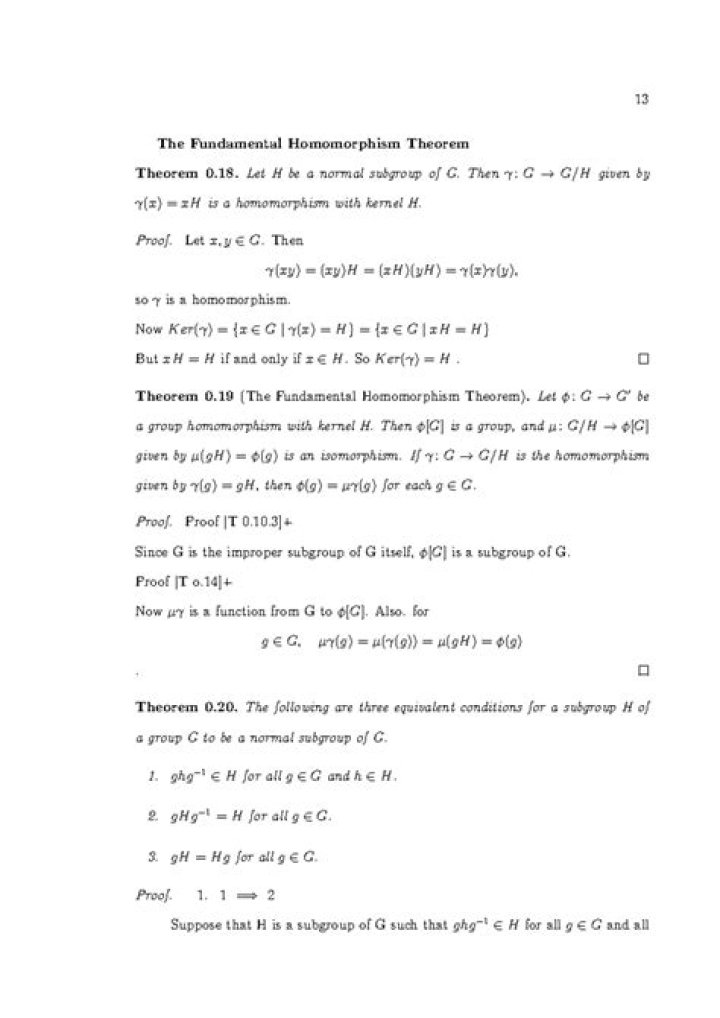
Let $\phi: G \to H$ be a group homomorphism with $K = \ker\phi$. Then $G/K \simeq \phi[G]. $
The hinge to the proof is to define $\Phi: G/K \to \phi[G]$ given by $\Phi(gK) = \phi(g)$. Then we must prove $\Phi$ an isomorphism and well-defined. I can do this, hence not asking about proofs or formality.
(1.) What’s the intuition? This has a picture but I'm still confounded.
(2.) Where did $\Phi(gK) = \phi(g)$ spring from? I want to understand this, not memorize it.
(3.) How is $\Phi(G/K) = \{ \Phi(gK) : g \in G \}$?
I know definitions $G/K = \{gK : g \in G \}$. For any function $f$, $f[S] = \{ f(s) : s \in S \}$
2 Answers
$\begingroup$Since you've done all the computations yourself and other posts have made them available to you as well, I will answer with my intuition on what the fundamental homomorphism (i.e. the first isomorphism theorem) does and what it is for.
The main thing that this tells you is that all homomorphic images of a group are determined by the group itself.
As you said: if $\varphi:G\rightarrow H$ is a homomorphism, the image, $\varphi[g]$, is isomorphic to $G/\operatorname{ker}\varphi$. Since $\operatorname{ker}\phi$ is a subgroup of $G$, that means $H$ doesn't have anything to do with $G/\operatorname{ker}\varphi$. If you were to go through all normal subgroups $N$ of $G$ and compute $G/N$, you would know every possible image that a homomorphism from $G$ could have, no matter what group it's going into.
In other words, we can pretty much forget about the homomorphism and just consider cosets of normal subgroups of $G$ and how they behave. Once you've figured out which normal subgroup of $G$ is sent to $0$ by a homomorphism, you've got all the information you need, and it simply becomes a matter of pairing elements of the quotient group (cosets of the kernel) with elements in the image of the homomorphism.
$\endgroup$ $\begingroup$The best way to see the problem is too show that there is one unique homomorphism $\Phi :G/K\rightarrow \phi[G]$ such that $\Phi\circ\nu=\phi$.
If $\Phi$ is a solution, then you have $\phi(g)=\Phi(\nu(g))=\Phi(gK)$.
You must also show that it defines a function. If $gK=g'.K$, then $\phi(g.g'^{-1})=e'$ and $\phi(g)=\phi(g')$. So the definition of $\Phi(gK)$ do not change if you take $g'$ such as $g'K=gK$.
$\Phi$ is obviously surjective, because $\phi$ is.
$\Phi$ is injective : if $\Phi(gK)=\Phi(hK)$ then $\phi(g)=\phi(h)$ and $g.h^{-1}\in K$, so $gK=hK$.
So $\Phi$ is an isomorphism between $G/K$ and $\phi[G]$
So the formula of the $(2)$ is the only one to be possible.
For the $(3)$, $\phi^{-1}[\{\phi(g)\}]= \{h\in G, \phi(h)=\phi(g)\}=\{h\in G, \phi(h.g^{-1})=e'\}$.
So it is :$\{h\in G, h.g^{-1}\in K\}$ id est $g.K$.
For the $(4)$, with your definitions, $\Phi(G/K)=\{\Phi(x), x\in G/K\}$. But $\{x\in G/K \}=\{g.K, g\in G\}$, so $\Phi(G/K)=\{\Phi(g.K), g\in G\}$.
$\endgroup$