Inverse of transformation matrix
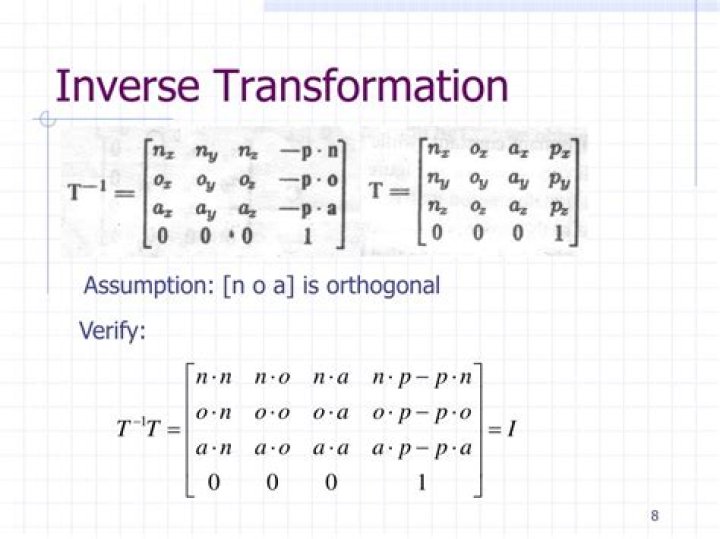
I am preparing for a computer 3D graphics test and have a sample question which I am unable to solve.
The question is as follows:
For the following 3D transfromation matrix M, find its inverse. Note that M is a composite matrix built from fundamental geometric affine transformations only. Show the initial transformation sequence of M, invert it, and write down the final inverted matrix of M.
$M =\begin{pmatrix}0&0&1&5\\0&3&0&3\\-1&0&0&2\\0&0&0&1\end{pmatrix} $
I only know basic linear algebra and I don't think it is the purpose to just invert the matrix but to use the information in the question to solve this.
Can anyone help?
Thanks
$\endgroup$ 34 Answers
$\begingroup$Here $4\times4$ matrix $M$ represents an affine transformation in 3D. It does so by conveniently combining a $3\times3$ matrix $P$ and a translation $v$ in a way that allows the affine transformation $Pu + v$ to be computed by a single matrix multiplication:
$$M \begin{pmatrix} u \\ 1 \end{pmatrix} = \begin{pmatrix} Pu + v \\ 1 \end{pmatrix} $$
where $M = \begin{pmatrix} P & v \\ 0 & 1 \end{pmatrix}$.
It follows that "undoing" the affine transformation can be accomplished by multiplying by $M^{-1}$:
$$M^{-1} = \begin{pmatrix} P^{-1} & -P^{-1}v \\ 0 & 1 \end{pmatrix} $$
Given that $M = \begin{pmatrix} 0 & 0 & 1 & 5 \\ 0 & 3 & 0 & 3 \\ -1 & 0 & 0 & 2 \\ 0 & 0 & 0 & 1 \end{pmatrix}$, one computes by any of a variety of ways:
$$M^{-1} = \begin{pmatrix} 0 & 0 & -1 & 2 \\ 0 & ^1/_3 & 0 & -1 \\ 1 & 0 & 0 & -5 \\ 0 & 0 & 0 & 1 \end{pmatrix}$$
$\endgroup$ $\begingroup$I know this is old, but the inverse of a transformation matrix is just the inverse of the matrix. For a transformation matrix $M$ which transforms some vector $\mathbf a$ to position $\mathbf v$, then to get a matrix which transforms some vector $\mathbf v$ to $\mathbf a$ we just multiply by $M^{-1}$
$M\cdot \mathbf a = \mathbf v \\ M^{-1} \cdot M \cdot \mathbf a = M^{-1} \cdot \mathbf v \\ \mathbf a = M^{-1} \cdot \mathbf v$
$\endgroup$ $\begingroup$$$\begin{pmatrix}0&0&1&5\\0&3&0&3\\-1&0&0&2\\0&0&0&1\end{pmatrix}$$ $$=\begin{pmatrix}0&0&1&0\\0&1&0&0\\1&0&0&0\\0&0&0&1\end{pmatrix}\begin{pmatrix}-1&0&0&2\\0&3&0&3\\0&0&1&5\\0&0&0&1\end{pmatrix}$$ $$=\begin{pmatrix}0&0&1&0\\0&1&0&0\\1&0&0&0\\0&0&0&1\end{pmatrix}\begin{pmatrix}-1&0&0&0\\0&3&0&0\\0&0&1&0\\0&0&0&1\end{pmatrix}\begin{pmatrix}1&0&0&-2\\0&1&0&1\\0&0&1&5\\0&0&0&1\end{pmatrix}$$
$$ =\begin{pmatrix}0&0&1&0\\0&1&0&0\\1&0&0&0\\0&0&0&1\end{pmatrix}\begin{pmatrix}-1&0&0&0\\0&3&0&0\\0&0&1&0\\0&0&0&1\end{pmatrix}\begin{pmatrix}1&0&0&-2\\0&1&0&0\\0&0&1&0\\0&0&0&1\end{pmatrix}\begin{pmatrix}1&0&0&0\\0&1&0&1\\0&0&1&5\\0&0&0&1\end{pmatrix} $$
$$ =\begin{pmatrix}0&0&1&0\\0&1&0&0\\1&0&0&0\\0&0&0&1\end{pmatrix}\begin{pmatrix}-1&0&0&0\\0&3&0&0\\0&0&1&0\\0&0&0&1\end{pmatrix}\begin{pmatrix}1&0&0&-2\\0&1&0&0\\0&0&1&0\\0&0&0&1\end{pmatrix}\begin{pmatrix}1&0&0&0\\0&1&0&1\\0&0&1&0\\0&0&0&1\end{pmatrix}\begin{pmatrix}1&0&0&0\\0&1&0&0\\0&0&1&5\\0&0&0&1\end{pmatrix} $$
The inverse of each factor individually is easy, so you can just compute those, then multiply in the reverse order to find the inverse of the matrix. (Remember for matrices $(AB)^{-1}=B^{-1}A^{-1}$, that is what I mean by reverse the factors.) Is this what you call fundamental affine transformations?
The first factor is permutes the rows, the second rescales them, then the last three are operations of the same type which produce a linear combination of of two rows.
$\endgroup$ 9 $\begingroup$I'll take a stab at a second method too, to see if that's what your teacher had in mind.
The idea is to use this post and/or this post, because:
$$M=\begin{pmatrix}0&0&1&0\\0&1&0&0\\1&0&0&0\\0&0&0&1\end{pmatrix}\begin{pmatrix}-1&0&0&2\\0&3&0&3\\0&0&1&5\\0&0&0&1\end{pmatrix}$$
$$=\begin{pmatrix}0&0&1&0\\0&1&0&0\\1&0&0&0\\0&0&0&1\end{pmatrix}\begin{pmatrix}-1&0&0&0\\0&3&0&0\\0&0&1&0\\0&0&0&1\end{pmatrix}\begin{pmatrix}1&0&0&-2\\0&1&0&1\\0&0&1&5\\0&0&0&1\end{pmatrix}$$
$$=\begin{pmatrix}0&0&1&0\\0&1&0&0\\1&0&0&0\\0&0&0&1\end{pmatrix}\begin{pmatrix}-1&0&0&0\\0&3&0&0\\0&0&1&0\\0&0&0&1\end{pmatrix}\left[\begin{pmatrix}1&0&0&0\\0&1&0&0\\0&0&1&0\\0&0&0&1\end{pmatrix}+\begin{pmatrix}0&0&0&-2\\0&0&0&1\\0&0&0&5\\0&0&0&0\end{pmatrix}\right]$$
You can see that the brackets have a unit plus a nilpotent $B$ ($B^2=0$). I think the link above might be able to help you invert that right half quickly.
Yes, of course here $(I+B)^{-1}=I-B$. So we know: $$M^{-1}=\begin{pmatrix}1&0&0&2\\0&1&0&-1\\0&0&1&-5\\0&0&0&1\end{pmatrix}\begin{pmatrix}-1&0&0&0\\0&1/3&0&0\\0&0&1&0\\0&0&0&1\end{pmatrix}\begin{pmatrix}0&0&1&0\\0&1&0&0\\1&0&0&0\\0&0&0&1\end{pmatrix}$$ which isn't so hard to compute. Multiply the left pair first, then with the final matrix on the right to get this in only a minute:
\begin{pmatrix}0&0&-1&2\\0&1/3&0&-1\\1&0&0&-5\\0&0&0&1\end{pmatrix}
$\endgroup$ 2