Is there a general way to solve transcendental equations?
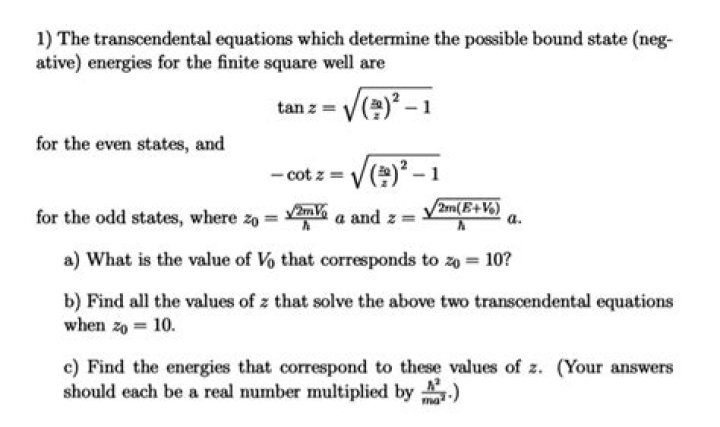
To make things definite, let's narrow them and call transcendental equation of the form
$$f(x) = 0$$
where $f$ is a real elementary function in the usual sense. For example
$$\cos(\pi x) + x^2 = 0$$or $$a = x \tan x$$
Is there a general way to solve such equations except for numerics? That is to produce an expression$$x_0 = \text{RHS}$$ where $\text{RHS}$ does not depend on $x_0$ and can be actually computed? Maybe in a form of series or something similar, not in "finite terms".
There is of course a question about the existance of solutions, it would be nice if the form of $\text{RHS}$ incorporatted the answer to it.
In the formulation above the problem seems to be equivalent to finding local inverse function.
$\endgroup$ 35 Answers
$\begingroup$Under certain assumptions you can use inversion of power series to obtain a solution. If $f(z)$ be analytic at $z_0$ where $f'(z_0)\ne 0$, then $w=f(z)$ has an analytic inverse $z=g(w)$ in some neighbourhood of $w_0=f(z_0)$, hence $$z-z_0=\sum_{k=1}^{\infty}a_k(w-w_0)^k$$ where $$a_k=\frac{1}{n!}\left[\frac{(z-z_0)^n}{(f(z)-w_0)^n}\right]^{(n-1)}_{z-z_0}$$
If the equation is of the form $$z=a+wf(z)$$ where $a$ is inside the domain of analyticity of $f(z)$ and $f(a)\ne 0$, then $$z=a+\sum_{k=1}^{\infty}\frac{w^k}{k!}\left[f^{k}(a)\right]^{(k)}$$ For example, a solution to the Kepler's equation $$z=m+E\sin z$$ can be expressed as follows $$z=m+E\sin m+\frac{E^2}{2!}(\sin m)' +...$$
Your second example can be written as $$z=w\cot z$$ So if you work your way through the formulae, you should be able to obtain some form of a solution.
$\endgroup$ $\begingroup$In general, the elementary functions are analytic except for some isolated singularities and branch cuts, so they and their local inverses will have convergent Taylor series expansions in suitable disks. Look up "reversion of series".
For example, with $f(x) = \cos(\pi x) + x^2$, a convenient starting point might be $x=1/2$ for which $f(x) = 1/4$. We have $$f(x) = {\frac {1}{4}}+ \left( 1-\pi \right) \left( x-{\frac {1}{2}} \right) + \left( x-{\frac {1}{2}} \right) ^{2}+\frac16\,{\pi }^{3} \left( x-{\frac {1}{2}} \right) ^{3}-{ \frac {1}{120}}\,{\pi }^{5} \left( x-{\frac {1}{2}} \right) ^{5}+\ldots $$ and then a solution of $f(x) = t$ is $$ x = {\frac {1}{2}}- \left( -1+\pi \right) ^{-1} \left( t-{\frac {1}{4}} \right) + \left( -1+\pi \right) ^{-3} \left( t-{\frac {1}{4}} \right) ^{2}-1/6\,{\frac {{\pi }^{4}-{\pi }^{3}+12}{ \left( -1+\pi \right) ^{5}}} \left( t-{\frac {1}{4}} \right) ^{3}+5/6\,{\frac {-{ \pi }^{3}+6+{\pi }^{4}}{ \left( -1+\pi \right) ^{7}}} \left( t-{ \frac {1}{4}} \right) ^{4}-{\frac {1}{120}}\,{\frac {{\pi }^{5}+9\,{ \pi }^{8}-17\,{\pi }^{7}+1680+7\,{\pi }^{6}-420\,{\pi }^{3}+420\,{\pi }^{4}}{ \left( -1+\pi \right) ^{9}}} \left( t-{\frac {1}{4}} \right) ^{5}+O \left( \left( t-{\frac {1}{4}} \right) ^{6} \right) $$
$\endgroup$ 7 $\begingroup$If your hope is to conclude with a statement like $x=\mathrm{RHS}$, where $\mathrm{RHS}$ is itself an expression using elementary functions, composition, rational numbers, and well-known constants, then you cannot even do this for general polynomial equations of degree $5$ or higher without using some kind of infinite process, like a series or a recursion. See here, for example.
This is not a full answer to your question though - you are also asking if solutions can be found through series.
$\endgroup$ $\begingroup$The equation x*tan(x)=w is treated in Burniston and Siewert 1973. They give integral expressions for the solution(s) x(w). When w>0, the smallest (positive) solution is, I think, given in the maple code which I developed from the Burniston and Siewert solution.
solInt := proc (w) local tr; evalf(sqrt((1/2)*Pi)*exp((1/2)*log(w)-evalf(Int(arctan((log((tr+1)/(-tr+1))+2*tr*w)/Pi)/tr, tr = 0 .. 1))/Pi)) end proc:
solInt(0.5); fsolve(X*tan(X) = 0.5, X, 0 .. 2); # both give about 0.65327
$\endgroup$ $\begingroup$There are some general methods for solving or deciding transcendental equations in closed form. "Closed form" means expressions of allowed functions (Wikipedia: Closed-form expression). If an equation is solvable in closed form depends therefore on the functions you allow.
a) Allow algebraic numbers as closed form:
At first you can look if the equation can have an algebraic number as solution. In an equation $f(x)=0$, the right-hand side, $0$, is an algebraic number. The left-hand side, $f(x)$, has to be therefore also an algebraic number. Look for which algebraic arguments the transcendental function $f$ can have algebraic function values.
Your first example $cos(\pi x)+x^{2}=0$: $x^{2}$ is algebraic if $x$ is algebraic. $cos(\pi x)$ is algebraic if $x$ is rational.
Your second example $x\tan(x)-a=0$, if $a$ is an algebraic number: Assume $x$ to be algebraic. $\tan(x)$ is algebraic only if $x=0$. Therefore the only algebraic solution of the equation could be $x=0$, if $0$ would be a solution.
b) Allow the members of a given class of certain functions as closed form:
A general method for solving a given equation $f(x)=0$ is to apply the compositional inverse $f^{-1}$ of $f$: $x=f^{-1}(0)$. In general, $f$ and $f^{-1}$ are correspondences. But often it is possible to split the problem into subproblems where $f$ and $f^{-1}$ are functions.
For applying this method, $f$ and $f^{-1}$ have to be known. That means they have to be in closed form.
There is a general method for the elementary functions.
The elementary functions are according to Liouville and Ritt those functions of one variable which are obtained in a finite number of steps by performing algebraic operations and taking exponentials and logarithms (Wikipedia: Elementary function).
The incomprehensibly unfortunately hardly noticed theorem of Joseph Fels Ritt in [Ritt 1925] Ritt, J. F.: Elementary functions and their inverses. Trans. Amer. Math. Soc. 27 (1925) (1) 68-90 answers which kinds of Elementary functions can have an inverse which is an Elementary function. You can also take the method ofRosenlicht, M.: On the explicit solvability of certain transcendental equations. Publications mathématiques de l'IHÉS 36 (1969) 15-22.
It is easy to prove a theorem that is in a certain sense opposite to Ritt's theorem: If $f$ is a function with $f=f_1\circ\ldots\circ f_n$, where $n\in\mathbb{N}_{\ge 1}$ and $\forall i\in\{1,...n\}\colon f_i\colon D_i\subseteq\mathbb{C}^{k_i}\to\mathbb{C}^{k_i}$, for each partial inverse $\phi$ of $f$, $\phi=\phi_n\circ\ldots\circ \phi_1$ holds, where $\forall i\in\{1,...n\}\colon \phi_i$ is a partial inverse of $f_i$.
Lin and Chow present some kinds of transcendental equations that are not solvable by elementary numbers.
[Chow 1999] Chow, T.: What is a closed-form number. Am. Math. Monthly 106 (1999) (5) 440-448
[Lin 1983] Ferng-Ching Lin: Schanuel's Conjecture Implies Ritt's Conjectures. Chin. J. Math. 11 (1983) (1) 41-50
If $f$ can be decomposed into compositions of algebraic functions and other known Standard functions than $\exp$ and $\ln$, an analog theorem to the theorem of Ritt of [Ritt 1925] could be applied. I hope to prove such a generalization of Ritt's theorem for this class of functions.
$\endgroup$More in general

What are the ramifications of clearing Fort Independence?

