Linear Transformations $ \mathbb R^2 \rightarrow \mathbb R^3 $
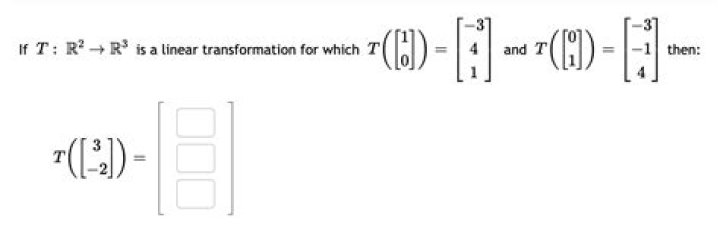
If $ T : \mathbb R^2 \rightarrow \mathbb R^3 $ is a linear transformation such that $ T \begin{bmatrix} 1 \\ 2 \\ \end{bmatrix} = \begin{bmatrix} 0 \\ 12 \\ -2 \end{bmatrix} $ and $ T\begin{bmatrix} 2 \\ -1 \\ \end{bmatrix} = \begin{bmatrix} 10 \\ -1 \\ 1 \end{bmatrix} $ then the standard Matrix $A = ?$
This is where I get stuck with linear transformations and don't know how to do this type of operation. Can anyone help me get started ?
$\endgroup$ 04 Answers
$\begingroup$Remember that $T$ is linear. That means that for any vectors $v,w\in\mathbb{R}^2$ and any scalars $a,b\in\mathbb{R}$, $$T(av+bw)=aT(v)+bT(w).$$ So, let's use this information. Since $$T \begin{bmatrix} 1 \\ 2 \\ \end{bmatrix} = \begin{bmatrix} 0 \\ 12 \\ -2 \end{bmatrix}, \qquad T\begin{bmatrix} 2 \\ -1 \\ \end{bmatrix} = \begin{bmatrix} 10 \\ -1 \\ 1 \end{bmatrix},$$ you know that $$T\left(\begin{bmatrix} 1 \\ 2 \\ \end{bmatrix}+2\begin{bmatrix} 2 \\ -1 \\ \end{bmatrix}\right)=T\left(\begin{bmatrix} 1 \\ 2 \\ \end{bmatrix}+\begin{bmatrix} 4 \\ -2 \\ \end{bmatrix}\right)=T\begin{bmatrix} 5 \\ 0\\ \end{bmatrix}$$ must equal $$T \begin{bmatrix} 1 \\ 2 \\ \end{bmatrix}+2\cdot T\begin{bmatrix} 2 \\ -1 \\ \end{bmatrix} =\begin{bmatrix} 0 \\ 12 \\ -2 \end{bmatrix}+2\cdot \begin{bmatrix} 10 \\ -1 \\ 1 \end{bmatrix}=\begin{bmatrix} 20 \\ 10 \\ 0 \end{bmatrix}.$$ So, we know $T\begin{bmatrix} 5 \\ 0\\ \end{bmatrix}$. Do you see how to find $T\begin{bmatrix} 1 \\ 0\\ \end{bmatrix}$? Then use the same process to figure out $T\begin{bmatrix} 0 \\ 1\\ \end{bmatrix}$.
After doing that, you should know how to make the (standard basis) matrix for $T$.
$\endgroup$ 2 $\begingroup$Hints:
Write every $\,v\in\Bbb R^2\,$ as
$$v=a\binom{1}{2}+b\binom{2}{\!\!-1}\;\;,\;\;a,b\in\Bbb R$$
Now, convince yourself that
$$Tv=a\,T\binom{1}{2} +b\,T\binom{2}{\!\!-1}$$
Finally, get the matrix representation for $\,T\,$ wrt to the given basis.
$\endgroup$ $\begingroup$(I assume that you want the matrix with respect to the standard basis). Let $$ v_1 = \pmatrix{1 \\ 2}\quad v_2 = \pmatrix{2\\-1}. $$ Note that $$ \pmatrix{1 \\ 0} = \frac{1}{5}(v_1 + 2v_2) $$ So $$ T\pmatrix{1 \\ 0} = \frac{1}{5}Tv_1 + \frac{2}{5}Tv_2 $$ This will be the first column in $A$.
Now do likewise to find the second column.
$\endgroup$ $\begingroup$since $(1,2)$and $(2,-1)$ are independence vector so they can be a basis for $ R^{2}$. and if you consider standard basis for $R^{3} \{(1,0,0),(0,1,0),(0,0,1)\}$. According to Linear Algebra writed by Hofman & Kenzy: $T_{\text non-stnadard}=[0,10;12,-1;-2,1](2 \times 3$ matrix) that first column is $T(1,2)$ in standard basis $(T(1,2)=0(1,0,0)+12(0,1,0)+-2(0,0,1)) $ and second column is $T(2,-1)$ at standard basis $(T(2,-1)=10(1,0,0)+-1(0,1,0)+1(0,0,1)). $
then consider A=[$\frac{1}{5}$,$\frac{2}{5}$;$\frac{2}{5}$,$\frac{-1}{5}$] (first column is coordinates of $(1,0)$ in base${(1,2),(2,-1)})$ and second column is coordinate of $(0,1)$ in base $\{(1,2),(2,-1)\}$
$T_{\text non-standard} *A $is matrix $T$ at standard basis .
$\endgroup$