Moment of inertia of a semicircle by simple integration.
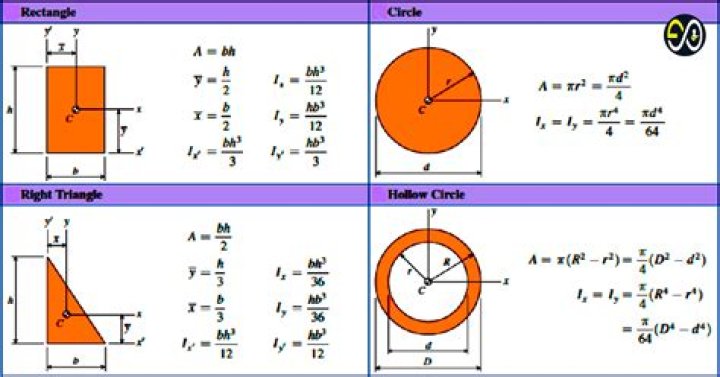
The problem asks to calculate the moment of inertia of a semicircle:
By simple integration using polar coordinates:
$I_x=\int^{\pi/2}_{-\pi/2} y^2 dA$
Choosing a differential element with area $dA$ , $dA$ = $\frac{r_0^2}{2}d\theta$
Where $r_0$ is the radius of the cricle.
y=$r_0sin\theta$
$I_x=\int^{\pi/2}_{-\pi/2} {r_0^2sin^2\theta} \frac{r_0^2}{2}d\theta$
which evaluates to $\frac{\pi r_0^4}{4}$ while the solution should be $\frac{\pi r_0^4}{8}$
Where did i go wrong ?
Thanks in advance!
$\endgroup$ 41 Answer
$\begingroup$You can also calculate the moment of inertia by using double integrals. Considering the semicircle you have is from -π/2 to π/2 the moment of inertia you re looking for with respect to the x axis will be: integrate y^2 with polar coordinates: the inside integral will be bounded by -π/2, π/2 (with respect to θ --> the angle) and the other one will be bounded by 0 to r--> radius of the circle (with respect to p). Don't forget the jacobian( it will be p) and obviously y^2 = p^2 * (sinθ)^2. (You will transfer (x,y) to (p,θ) ).
$\endgroup$