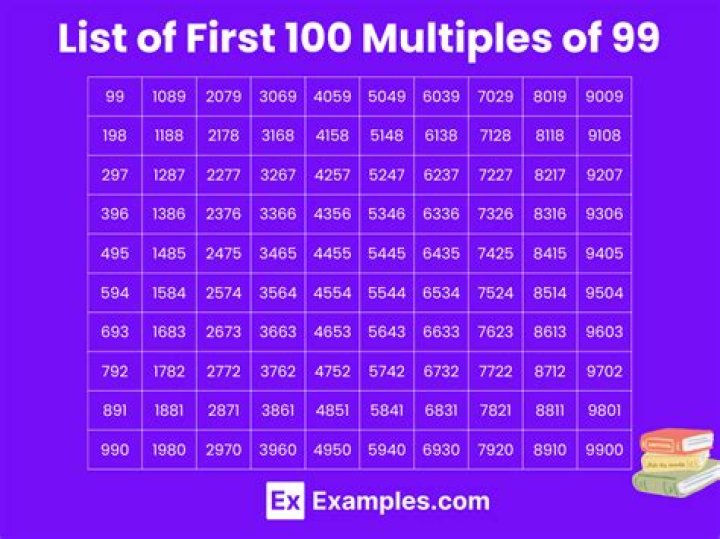
Multiples of 99.
If the 18-digit number $A3640548981270644B$ is divisible by $99$, what are all the possible values of $(A, B)$?
I understand that the multiples of $99$, must end with $1$ or $9$. So, I took different combinations of $1 \& 9$ as : $1,9\;; 9,1\;; 1,1$ and $9,9$
I divided $136405489812706449/99=15156165534745161/11$ (not exact);
$936405489812706441/99=9458641311239459$ (exact);
$136405489812706441/99=$Irreducible;
$936405489812706449/99=$Irreducible.
So, the answer should be $A=9$ and $B=1$, which is one pair of $A$ & $B$ only.
Is this solution correct?... Please advise.
$\endgroup$ 43 Answers
$\begingroup$The divisibility test for $9$ generalizes to other bases:
To test if a number is divisible by $d$, write it in base $d+1$ and add up the "digits". The original number is a multiple of $d$ if and only if the sum of base-$(d+1)$ digits is.
This is relevant here, because it is easy to convert from base ten to base hundred.
So your number is divisible by $99$ exactly if $$A3+64+05+48+98+12+70+64+4B$$ is -- and that is the same as $$(43+64+05+48+98+12+70+64)+AB$$
Therefore, if we sum $43+64+5+48+98+12+70+64$ modulo $99$ we get the answer. If the sum is $0\pmod{99}$, then $AB$ can be $00$ or $99$; if it's anything else, $AB$ is exactly $99$ minus the sum modulo $99$.
$\endgroup$ 1 $\begingroup$The condition of divisibility by 9 gives:
$A +71 + B= 9 k_1$
Where 71 is the sum of digits between A and B and $k_1$ is an integer. The condition of divisibility by 11 by alternating sum of digits gives:
$A +3 -B= 11 k_2$
Where 3 is alternating sum of digits between A and B and $k_2$ is an integer. The minimum possible multiple of 11 is when $k_2=1$, that is we have $A+3-B=11$ the only solution of this equation is $A=9$ and $B=1$ which also satisfy the first relation.
$\endgroup$ 2 $\begingroup$Your answer is correct, but your solution is not correct.
For example, $99\cdot 2=198$ which does not end with $1$ and $9$.
One possibility is to apply the rules for divisibility by $9$ and by $11$ if you know them. This gives two equations for $A$ and $B$ and then you can compute them.
$\endgroup$