Mutually Exclusive Events (or not)
Suppose that P(A) = 0.42, P(B) = 0.38 and P(A U B) = 0.70. Are A and B mutually exclusive? Explain your answer.
Now from what I gather, mutually exclusive events are those that are not dependent upon one another, correct? If that's the case then they are not mutually exclusive since P(A) + P(B) does not equal P(A U B). If it was P(A U B) = 0.80 only then it would have been considered mutually exclusive. Correct?
$\endgroup$4 Answers
$\begingroup$"Mutually exclusive" and "independent" do not mean the same thing: they are different.
"Mutually exclusive events are those that are not dependent upon one another, correct?"
NO:
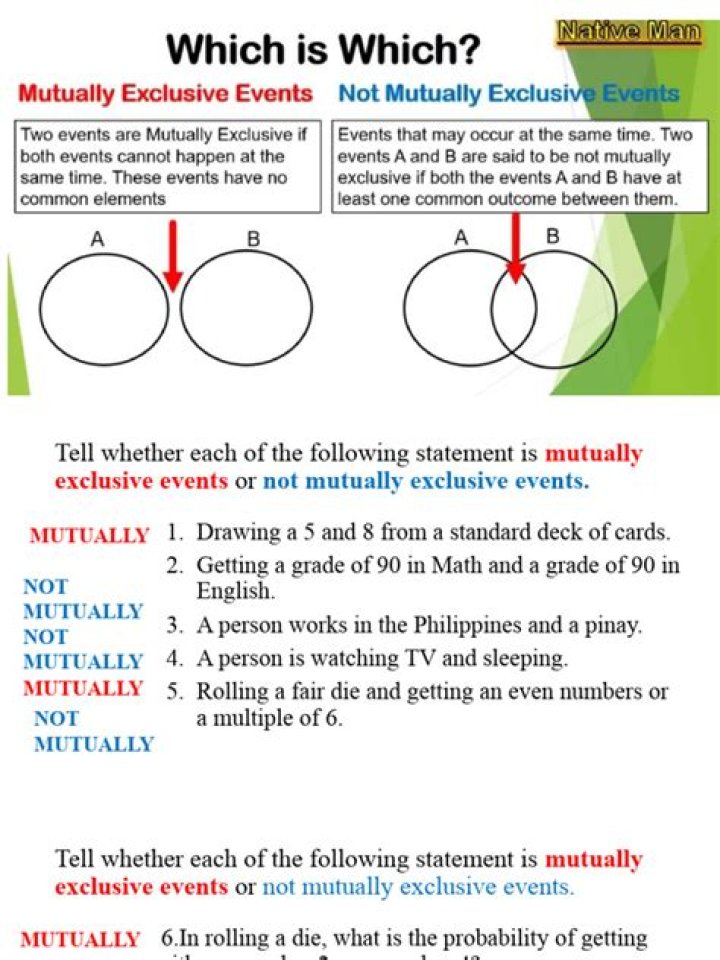
Two events are mutually exclusive if they cannot both occur. If we flip a coin, we get either a head, or a tail. We cannot get both. That is, the events are mutually exclusive.
Independent events are events where knowing the outcome of one doesn't change the probability of the other. Knowing that it's a sunny day doesn't tell me anything about the outcome of rolling a die. Those "events" are independent of one another.
When events are mutually exclusive, their probabilities add up to the probability that one event (or the other) occurs. In this case, if the $A$ and $B$ were mutually exclusive events, then you are correct, we would need for $P(A) + P(B) = 80$. But what we have, as you point out, is that $\,P(A) + P(B) = 70\neq 80.\;$ So you're right that $A$ and $B$ are not mutually exclusive, and for the right reason - because $P(A) + P(B) \neq P(A\cup B)$ - though you want to be clear about the terminology you use.
$\endgroup$ 2 $\begingroup$No, mutually exclusive events are events that cannot occur simultaneously: they are disjoint. If $A$ and $B$ are disjoint, then $\Bbb P(A\cup B)=\Bbb P(A)+\Bbb P(B)=0.42+0.38=0.80$. That’s not the case here, so $A$ and $B$ are not mutually exclusive.
In other words, your calculations and probably your reasoning are correct, but your use of terminology is not: mutually exclusive does not mean independent.
$\endgroup$ 2 $\begingroup$You are correct in your second conjecture (about $0.80$), but not in your former. Events that are not dependent upon one another are called (appropriately enough) independent, while mutually exclusive events cannot both occur, so are certainly dependent on one another when neither event is "impossible" (since, if one happens, then the other is "impossible").
$\endgroup$ $\begingroup$$A$ and $B$ are mutually exclusive if $P(A\cap B)=0$.
Now for arbitrary $A$ and $B$, $P(A\cup B)=P(A)+P(B)-P(A\cap B)$. This should give you what you need.
$\endgroup$