Notion of arbitrary unions and intersections
I'm trying to read some document that deals with arbitrary unions and intersections, but I don't know the concept behind it. Could someone please explain it to me in a clear way?
I kind of understand that if we have a set I and for each $i\in I$ we are given a set $A_{i}$ and that an arbitrary intersection consists of all elements and an arbitrary union consists of some elements (bear with my horrible explanation), however I don't get the concept behind it (this is why I can't explain it that well).
$\endgroup$2 Answers
$\begingroup$If you have a lot of sets and you want the union of some of them, it can be hard to describe what you want unless each of the sets has a name. If there aren't too many sets, you can name them with natural numbers: Set #1, Set #2, and so on, and you can abbreviate that by calling the sets $S_1$, $S_2$, and so on.
Suppose you want the union of all the odd-numbered sets: $S_1 \cup S_3 \cup \cdots$. You can write the union you want as $\bigcup_{i\in\mathbb{N}} S_{2i+1}$, and if you let $\mathbb{O}^+$ be the set of positive odd integers, you can write the same union as $\bigcup_{i\in\mathbb{O}^+} S_i$.
Sometimes sets have names other than #1, #2, ... . Perhaps there are uncountably many sets, or perhaps another naming convention is more useful. For example, you might define open disk-shaped sets in the plane centered at the origin and having radius $r>0$ and want to name them by their radius: $$B_r= \left\{(x,y)\in\mathbb{R}^2 \mid x^2+y^2<r\right\}\textrm.$$ (These sets happen to be nested within one another, so they might not be the most interesting choice of example.)
Then you can define all kinds of unions and intersections of these using the notation for arbitrary unions and intersections. For example, you can let $S=\bigcap_{r\in\mathbb{Q}^+} B_r$, which is the set of points in $\mathbb{R}^2$ contained in every $B_q$ where $q$ is a positive rational number. (It turns out that $S=\{(0,0)\}$.) Or you might want to show that the union of all these sets equals $\mathbb{R}^2$, which you could say this way: $\mathbb{R}^2=\bigcup_{r\in\mathbb{R}}B_r$ .
I know that's a long answer, but I hope it helps.
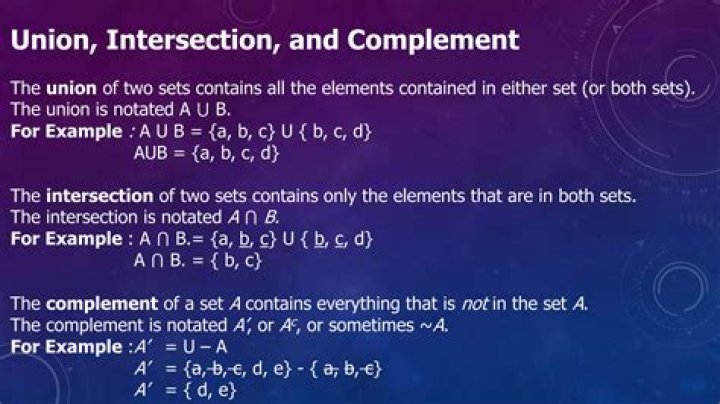
$\endgroup$ 2 $\begingroup$Just like the union $A\cup B$ is the collection of elements which appear in some of the sets $A$ and $B$ (either one or both), and the intersection $A\cap B$ is the set of those which appear in both, we define arbitrary unions and intersections like this:
Suppose that $\{A_i\mid i\in I\}$ is a set of sets. We define $$\bigcup_{i\in I}A_i=\{x\mid\exists i\in I:x\in A_i\}\\\bigcap_{i\in I}A_i=\{x\mid\forall i\in I:x\in A_i\}$$
That is, $\bigcup_{i\in I} A_i$ is the set of all those elements which appear in some $A_i$, and $\bigcap_{i\in I}A_i$ is the set of those elements which appear in every $A_i$.
$\endgroup$ 2More in general
‘Cutter’s Way’ (March 20, 1981)

