Proof of continuity of Thomae Function at irrationals.
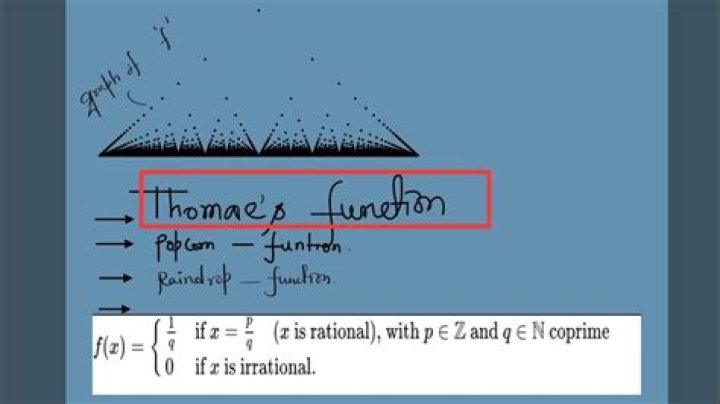
$$ \begin{align} t(x) = \begin{cases} 0 & \text{if $x$ is irrational}\\ \frac{1}{n} & \text{if $x = \frac{m}{n}$ where $\gcd(m,n) = 1$} \end{cases} \end{align} $$
I can prove the discontinuity at rational $b$ by taking a sequence of irrationals $x_n$ which converge to $b$.
But while going through an argument for continuity at irrationals. I found this in a book.
On the other hand if $b$ is an irrational number and $\epsilon > 0$ then there is a natural number $n_0$ such that $1/n_0 < \epsilon$. There are only finite number of rationals with denominator less than $n_0$ in the interval $(b-1,b+1)$. Hence we can find a $\delta > 0$ such that $\delta$ neighbourhood of $b$ contains no rational with denominator less than $n_0$.
I understand the rest of the proof. But I am unable to prove the emphasized text. Although I find it intuitive.
$\endgroup$ 34 Answers
$\begingroup$Let $m=n_0-1$, so we want to consider rationals with denominators $1,\cdots,m$ in the interval $(b-1,b+1)$. Since consecutive rationals with denominator k differ by $1/k$ and the interval $(b-1,b+1)$ has length 2, there are at most 2k rationals with denominator k in $(b-1,b+1)$.
Therefore there are at most $2\cdot1+2\cdot2+\cdots+2m$ rationals in $(b-1,b+1)$ with denominator less than $n_0$, so we can choose a $\delta$ with $0<\delta<|b-r|$, where r is the rational with denominator less than $n_0$ in $(b-1,b+1)$ which is closest to b.
$\endgroup$ 4 $\begingroup$Let $b \in \mathbb{R} \setminus \mathbb{Q}$. Given $\epsilon > 0$ let $K = \left \lceil \frac{1}{\epsilon} \right \rceil$. Thus, $\frac{1}{K} < \epsilon$.
Note that $K$ is a finite number and the number of integers less than $K$ is also finite. This means the number of rationals of the form $\frac{1}{q} > \frac{1}{K}$ is also finite.
Shrink the interval $(b-1, b+1)$ down to $(b-\delta, b+ \delta )$ such that all these $\frac{1}{q}$ are tossed out, leaving only rationals $\frac{1}{q} < \frac{1}{K} < \epsilon$.
It follows that if $|x -b| < \delta$ then $|f(x) - f(b) | = |f(x)| \leq \frac{1}{K} < \epsilon$.
$\endgroup$ 3 $\begingroup$Let $\frac{m}{n}$ be a rational number such that $$b-1 \leq \frac{m}{n} \leq b+1,$$ where $m$ and $n$ are integers such that $n> 0$ and $\gcd (m, n) = 1$.
Then we see that$$ n ( b-1) \leq m \leq n(b+1).$$Thus, $$ m \in \mathbb{Z} \cap \left[ \ n(b-1), \ n(b+1) \ \right].$$Therefore,$$m \in \left\{ \ \lceil n(b-1) \rceil, \ldots, \lfloor n(b+1) \rfloor \ \right\},$$where $\lfloor 2.5 \rfloor = 2$ and $\lceil 2.5 \rceil = 3$, and $\lfloor 2 \rfloor = 2 = \lceil 2 \rceil$.
Hence, for each natural number $n$, there are at most$$N \colon= \lfloor n(b+1) \rfloor - \lceil n(b-1) \rceil$$rational numbers with denominator $n$ in the closed interval $[b-1, b+1]$ and hence in the open interval $(b-1, b+1)$.
$\endgroup$ 2 $\begingroup$The natural extension of Thomae's function to the hyperreals is defined by the same formula: $$ \begin{align} t(x) = \begin{cases} \frac{1}{n} & \text{if $x = \frac{m}{n}$ where $m,n\in{}^\ast\mathbb N$ and $\gcd(m,n) = 1$} \\ 0 & \text{otherwise.}\\ \end{cases} \end{align} $$ To show that $t(x)$ is continuous at $c\in\mathbb R\setminus \mathbb Q$, suppose $q$ is a hyperrational infinitely close to $c$. Clearly $q\not\in\mathbb R$. Since $q$ is appreciable (i.e., finite but not infinitesimal), its denominator $n$ is necessarily an infinite hyperinteger. Hence $t(q)=\frac{1}{n}\approx 0$ where $\approx$ is the relation of infinite proximity. Thus $t(x)$ is infinitesimal at all points infinitely close to $c$, proving the continuity of $t(x)$ at $c$.
$\endgroup$