Proof of the First Isomorphism Theorem for Rings [duplicate]
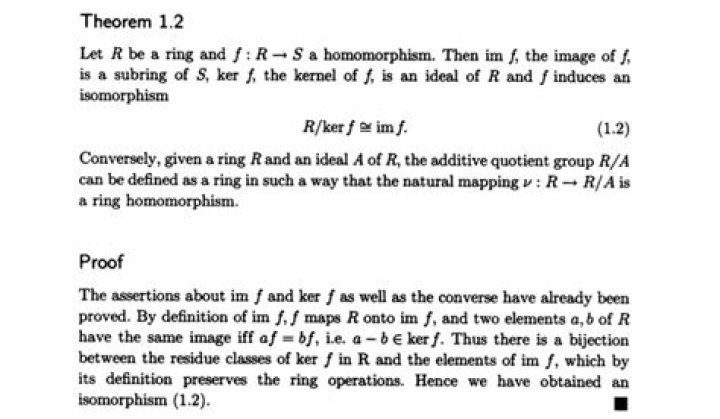
The statement is the First Isomorphism Theorem for Rings from Abstract Algebra by Dummit and Foote. I'd like to check if all is ok. In particular I'm a bit worried about the (*) line. It looks a bit awkward, but is it too bad? Any suggestions?
Theorem:
1) If $\varphi:R \rightarrow S$ is a homomorphism of rings, then the kernel of $\varphi$ is an ideal of $R$, the image of $\varphi$ is a subring of $S$ and $R/ker \varphi$ is isomorphic as a ring to $\varphi(R)$.
2) If $I$ is any ideal of $R$, then the map $R \rightarrow R/I$ defined by $r \rightarrow r+I$ is a surjective ring homomorphism with kernel $I$. Thus every ideal is the kernel of a ring homomorphism and vice versa.
Proof: Let $\varphi: R \rightarrow S$ be a ring homomorfism. If $r \in R$ and $r' \in ker \varphi$, then we have $rr',r'r \in ker \varphi$ (so that it is closed under multiplication by elements of $R$) since $$\varphi (rr')=\varphi (r) \varphi (r')=\varphi (r)0 =0=0 \varphi (r)=\varphi (r') \varphi (r)=\varphi (r'r);$$ since $ker \varphi$ is also a subring of $R$, it is an ideal of $R$. It's clear that $\varphi (R)$ is a subring of $S$. Now, let $I$ be an ideal of $R$, so that $R/I$ is also a ring, and define $\pi:R \rightarrow R/I$ by $\pi (r)=r+I$. We know $\pi$ is a group homomorphism with kernel $I$, and for $r,s \in R$, we have $$\pi (rs)=(rs)+I=(r+I)(s+I)=\pi (r) \pi (s),$$ so that $\pi$ is in fact a ring homomorphism. Define then $\phi: R/ker \varphi \rightarrow \varphi(R)$ by $$\phi (r+(ker \phi))= \varphi (r),$$ for each $(r+(ker \phi)) \in R/ker \varphi$, for some $r \in R$. This is well defined because if $r' \in (r+(ker \varphi)),$ then $$\phi (r'+(ker \varphi))=\varphi(r')=\varphi(r)=\phi (r+(ker \varphi)).$$ Also, this is a ring isomorphism because for each $\varphi (s) \in \varphi (R)$ for some $s \in R$, we have $$(*) \ \phi^{-1}\{\varphi (s)\}= \phi^{-1} \varphi[r+(ker \varphi)]= \phi^{-1} \varphi[\pi^{-1} \{r+(ker \varphi)\}]= \{r+(ker \varphi)\},$$ a set with a single element of $R/ker \varphi$, so that it is a bijection, and for every $r+(ker \varphi), r'+(ker \varphi) \in R/ker \varphi$, for some $r,r' \in R$, we have $$\phi [(r+(ker \varphi))+(r'+(ker \varphi))]=\phi [(r+r')+(ker \varphi)]=\varphi(r+r')=\varphi(r)+ \varphi(r')=\phi [r+(ker \varphi)]+ \phi [r'+(ker \varphi)],$$ and $$\phi [(r+(ker \varphi)) (r'+(ker \varphi))]=\phi [(rr')+(ker \varphi)]=\varphi(rr')=\varphi(r) \varphi(r')=\phi [r+(ker \varphi)] \phi [r'+(ker \varphi)],$$ so that it is a ring homomorphism.
$\endgroup$ 01 Answer
$\begingroup$Basically, I think you know what you are proving. But it's not really "straight to the point", and not very clear.
For example, when you are proving the well-defineness of $\phi$, you haven't stated explicitly why $ \dots = \phi(r') = \phi(r) = \dots$. So, I'll fix that for you. To prove that $\phi$ is well-defined, you must prove that $\phi$ maps 1 element of $R/\text{ker}\varphi$ to 1 and only 1 element of $\varphi(R)$. So, let $r' + \text{ker}\varphi = r + \text{ker}\varphi$, we'll prove that $\phi(r' + \text{ker}\varphi) = \phi(r + \text{ker}\varphi)$. Since we have $r' + \text{ker}\varphi = r + \text{ker}\varphi$, that means $r' - r \in \text{ker}\varphi$, so $\varphi(r' - r) = 0$, hence $\varphi(r') = \varphi(r)$, and finally, this yields $\phi(r' + \text{ker}\varphi) = \phi(r + \text{ker}\varphi)$
It's obviously that $\phi$ is a ring homomorphism.
$\phi$ is injective, say, we have: $r + \text{ker}\varphi \in \ker \phi$, i.e $0 = \phi(r + \text{ker}\varphi) = \varphi(r)$, which means $r \in \text{ker}\varphi$, which then implies $r + \text{ker}\varphi = 0 + \text{ker}\varphi$. So $\ker \phi = \{0 + \ker \varphi\}$.
$\phi$ is surjective, since for every $y \in \varphi(R)$, there exists $r \in R$, such that $y = \varphi(r) = \phi(r + \ker \varphi)$.