Proving Set Equivalence Using Set Laws [closed]
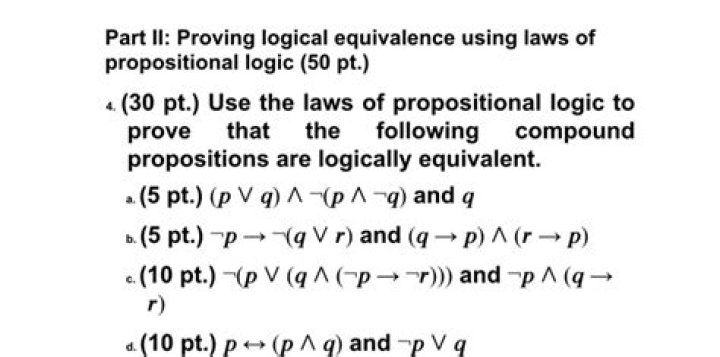
I am having trouble proving set equivalence for the following question:
$$A \setminus A \cap B=A \cap B'$$
I understand that both sides are equivalent, however I am struggling to use set laws to prove this. I was wondering how set laws can be applied to this question to prove that it is true?
$\endgroup$ 32 Answers
$\begingroup$\begin{align} &A\setminus (A\cap B) \\ &= A \cap (A\cap B)^c \\ &=A\cap (A^c\cup B^c) \\ &= (A \cap A^c)\cup (A\cap B^c) \\ &= \emptyset\cup (A\cap B^c) \\ &=(A\cap B^c). \end{align}
Let's see how we can justify these guys.
Equality 1: is an application of the defn of "setminus". That is, $X\setminus Y= X \cap Y^c$
Equality 2: Is De Morgan's Law.
Equality 3: This would be justified as "Intersection distributes over unions" that is, $X\cap (Y \cup Z) = (X \cap Y) \cup (X \cap Z)$.
Equality 4: Follows from the definition of a complement. $X^c \cap X=X \cap X^c=\emptyset$
Equality 5: Follows from the definition of the emptyset. $X \cup \emptyset =\emptyset \cup X=X$
$\endgroup$ 2 $\begingroup$The basics for proving that two sets, $A$ and $B$, are equal is to show that $A \subseteq B$, so that within some universal set, $U$, $\forall x, x \in A \implies x \in B$ , and $B \subseteq A$, so that $\forall x, x \in B \implies x \in A$. If both sets are contained with one another, they must be the same set, in the same way that, for any two real numbers, $x \leq y \wedge x \geq y \implies x = y$.
To prove this, take some arbitrary element in the left-hand side and prove that it is also an element of the right-hand side. Since the element is arbitrary, it also holds for any element of that set. This establishes that the left set is a subset of the right set. Then, establish the same in the opposite direction.
Proposition. $A \setminus (A \cap B) \subseteq A \cap B^c$
Take $x \in A \setminus (A \cap B)$. So, by definition of the set-theoretic difference, $x \in A$ and $x \not \in A \cap B$. Since $x \not \in A \cap B$, $x \not \in A$ or $x \not \in B$. But, $x \in A$, so $x \not \in A$ would establish a contradiction. So, clearly, $x \not \in B$. Then, by the definition of a set complement, $x \in B^c$. So, we've established $x \in A$ and $x \in B^c$. So, by the definition of the intersection of sets, $x \in A \cap B^c$. So, $x \in A \setminus (A \cap B) \implies x \in A \cap B^c$. Therefore, $A \setminus (A \cap B) \subseteq A \cap B^c$.
Let's do the same in the opposite direction. I'd recommend doing this as an exercise before reading the proof below.
Proposition. $A \cap B^c \subseteq A \setminus (A \cap B)$
Let $y \in A \cap B^c$. By the definition of set intersection, $y \in A$ and $y \in B^c$. Since $y \in B^c$, $y \not \in B$. So, clearly, $y \not \in A \cap B$, as this only requires $y \not \in A$ or $y \not \in B$ (DeMorgan's Law, though this is a somewhat transformed version of it). So, we're done: $y \in A$ but $y \not \in A \cap B$, so $y \in A \setminus (A \cap B)$, so $y \in A \cap B^c \implies y \in A \setminus (A \cap B)$, and $A \setminus (A \cap B) \subseteq A \cap B^c$.
So, both sets are subsets of each other, and thus the same set.
$\endgroup$ 1More in general

"Zoraya ter Beek, age 29, just died by assisted suicide in the Netherlands. She was physically healthy, but psychologically depressed. It's an abomination that an entire society would actively facilitate, even encourage, someone ending their own life because they had no hope. Th…"

