Quadratic vertex form - negative $h$ means it's on the right side of the graph?
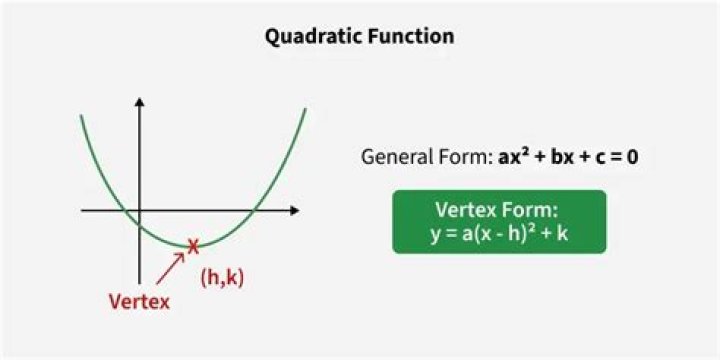
When putting a quadratic equation in vertex form, I am having difficulty understanding why $h$ is negative when the location of the parabola goes to the right... why is this?
For example, if I have... $y = -2(x-2)^2+9$
I understand that
- $a$ is -2, which means that it is a down-facing parabola
- $k$ is 9, which means that its vertex is positive and above the x-axis
I do not understand that since $k$ is negative, that means the location of the parabola is on the right side of the graph? Shouldn't it be on the left side, since it is negative? Also, when using a Flash quadratic graph displaying tool, it produces these results:
When I specify $h$ to be positive, it comes out to be negative in the quadratic equation. What's up with this?
Thanks
$\endgroup$5 Answers
$\begingroup$Look at a simpler problem. You know what the graph of $y=x$ looks like, yes? Now think about the graph of $y=x-7$. If you can understand why that's shifted to the right by $7$, and not to the left, you're well on the way to answering your parabola question.
$\endgroup$ 0 $\begingroup$Look at $(x-2)^2$, and calculate this for, say, $x=2+1/3$ and $x=2-1/3$. In either case you get $1/9$. Now calculate at $x=2+4$ and at $x=2-4$. In either case you get $16$.
Calculate $(x-2)^2$ at $x=2+t$ and at $x=2-t$. If you do the algebra carefully, you will get an answer of $t^2$ in each case. So going $t$ to the right of $x=2$, and going $t$ to the left, gives the same $y$-value.
Geometrically, that means that the curve is symmetrical about the vertical line with equation $x=2$, that this line is the axis of symmetry of the parabola.
Basically the same thing would happen with $(x-5)^2$. The line $x=5$ would be an axis of symmetry.
Now repeat the calculation with say $(x+3)^2$. If you put $x=-3+t$, and $x=-3-t$, in each case you will get $t^2$. The line $x=-3$ is the axis of symmetry.
$\endgroup$ $\begingroup$In addition to the other answers, it may help to think of the vertex-form equation in a slightly different format, moving $k$ to the same side as $y$: $$y-k=a(x-h)^2$$ This is like $y=x^2$, but stretched in some fashion (I'm intentionally vague here) to get $y=ax^2$, then shifted by $\langle h,k\rangle$, moving the vertex from $(0,0)$ to $(h,k)$ to get $y-k=a(x-h)^2$.
That is, changing $x\mapsto x-h$ and $y\mapsto y-k$ in the equation moves the graph right $h$ and up $k$.
$\endgroup$ $\begingroup$The parameter $h$ is the extremal point of the quadratic. The extremum happens when $x=h$, when the function $(x-h)^2$ is minimized (or $-(x-h)^2$ maximized). So the reason for the minus sign is because $x=h$ is equivalent to $x-h=0$.
$\endgroup$ $\begingroup$(X-2) means the parabola is shifted to the right (X-(-2)) or (X+2) means it shifts to the left.
Just remember that when it comes to vertex form and parabola transformations a negative h means shift right and positive h left.
We anumberd to the number lgraphbitself itself having negative integers on left and positive on right and I can see why this throws people off.
Best way to fix is think of it as a reverse of that.
$\endgroup$More in general

"Zoraya ter Beek, age 29, just died by assisted suicide in the Netherlands. She was physically healthy, but psychologically depressed. It's an abomination that an entire society would actively facilitate, even encourage, someone ending their own life because they had no hope. Th…"

