Questions about the addtion of injective and surjective functions
I have a question which is as follows,
Consider $f:\mathbb{R} \to \mathbb{R}$ and $g:\mathbb{R} \to \mathbb{R}$. Define the sum of $f$ and $g$ as the funtion $h:\mathbb{R} \to \mathbb{R}$ such that $h(x)=f(x)+g(x)$ for all $x \in \mathbb{R}$.
If both $f$ and $g$ are injective, will $h$ be injective? If only one of $f$ or $g$ is injective will $h$ be injective?
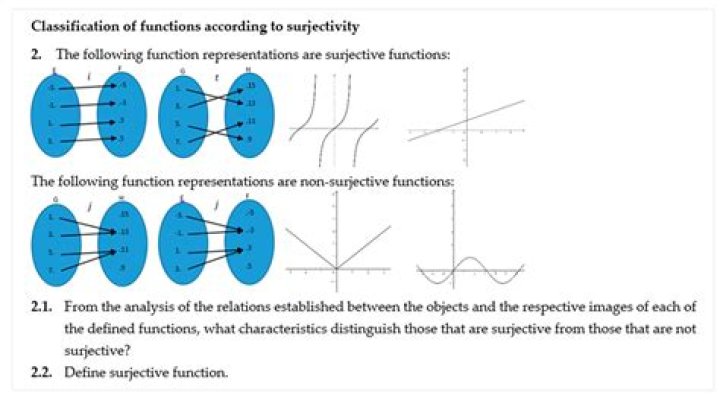
And also, if both $f$ and $g$ are surjective, will $h$ be surjective? If only one of $f$ or $g$ is surjective will $h$ be surjective?
I think that if both $f$ and $g$ are injective, then $h$ may not be injective and I can find a counter example to show that when both $f$ and $g$ are injective, $h$ is not injective.
But I have no idea on how to approach the rest of the question. Please give me some hints on how to do this, especially the part of the question asking if only one of $f$ and $g$ is injective and surjective, thanks to anybody who can help.
$\endgroup$ 12 Answers
$\begingroup$Hint: Take $f(x)=x$ and $g(x)=-x$. Works as a counter-example for both.
$\endgroup$ 3 $\begingroup$Both are false- and "one example rules them all".
Take $f$ to be any bijective function, and $g(x)=-f(x)$.
$\endgroup$ 2