SAS triangle angles
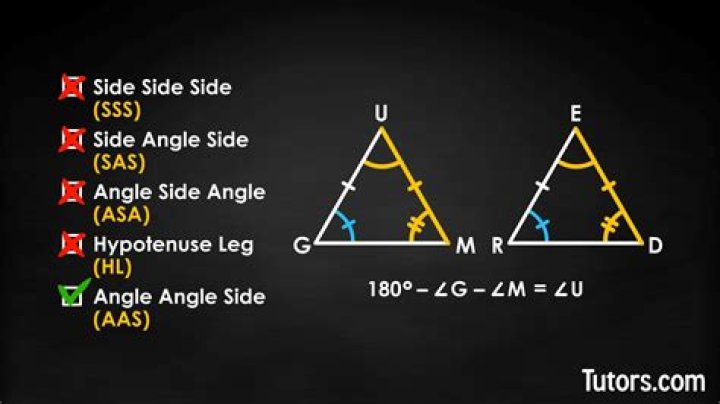
Let $\triangle ABC$ be any triangle with known sides $a$, $b$ and known angle $C$. Determine the remaining side and angles. (The naming convention of angle $A$ being opposite side $a$ etc. is used.)
Attempt:
By the law of cosines we get
$$ c= \sqrt{a^2+b^2-2ab\cos(C)} $$
Now by the law of sines it must hold that
$$ \sin(A) = \frac{a\sin(C)}{c} $$
This has two solutions but when I draw examples of triangles with the known criteria, I only get one triangle. Why is this and which of the two solutions to the equation should I use?
EDIT:
The book I'm using claims that if $\sin(v)=x$ then there are two possible solutions $v=\sin^{-1}(x)$ or $v=180\deg - \sin^{-1}(x)$.
$\endgroup$ 43 Answers
$\begingroup$Hint
Now that you have all sides you can use cosine rule for the other angles and you don't have to worry about signals.
$\endgroup$ 1 $\begingroup$For the two values you get from the law of sines, see which ones make sense geometrically. It's possible that one angle will be too large to satisfy the "$180$ total degrees in a triangle" requirement.
To verify this, simply use the fact that $A+B+C = 180^\circ$ to solve for the third angle (which would be $B$ for the example you wrote). If $B < 0$ then you can toss out that corresponding solution for $A$. Note that you'll need to go through this process anyway so it's really not any extra work.
EDIT: I forgot that sometimes there actually is another very small extra step required for the law of sines. See comments on this answer for details.
$\endgroup$ 5 $\begingroup$For a $\triangle\text{ABC}$, we know that (for EVERY triangle):
$$ \begin{cases} \angle\alpha+\angle\beta+\angle\gamma=\pi\\ \\ \frac{\left|\text{A}\right|}{\sin\angle\alpha}=\frac{\left|\text{B}\right|}{\sin\angle\beta}=\frac{\left|\text{C}\right|}{\sin\angle\gamma}\\ \\ \left|\text{A}\right|^2=\left|\text{B}\right|^2+\left|\text{C}\right|^2-2\left|\text{B}\right|\left|\text{C}\right|\cos\angle\alpha\\ \\ \left|\text{B}\right|^2=\left|\text{A}\right|^2+\left|\text{C}\right|^2-2\left|\text{A}\right|\left|\text{C}\right|\cos\angle\beta\\ \\ \left|\text{C}\right|^2=\left|\text{A}\right|^2+\left|\text{B}\right|^2-2\left|\text{A}\right|\left|\text{B}\right|\cos\angle\gamma \end{cases} $$
In your question, you say that $\left|\text{A}\right|$, $\left|\text{B}\right|$ and $\angle\gamma$ are known values.
So, in the system of equations we know:
$$ \begin{cases} \angle\alpha+\angle\beta+\color{red}{\angle\gamma}=\pi\\ \\ \frac{\color{red}{\left|\text{A}\right|}}{\sin\angle\alpha}=\frac{\color{red}{\left|\text{B}\right|}}{\sin\angle\beta}=\frac{\left|\text{C}\right|}{\color{red}{\sin\angle\gamma}}\\ \\ \color{red}{\left|\text{A}\right|^2}=\color{red}{\left|\text{B}\right|^2}+\left|\text{C}\right|^2-2\color{red}{\left|\text{B}\right|}\left|\text{C}\right|\cos\angle\alpha\\ \\ \color{red}{\left|\text{B}\right|^2}=\color{red}{\left|\text{A}\right|^2}+\left|\text{C}\right|^2-2\color{red}{\left|\text{A}\right|}\left|\text{C}\right|\cos\angle\beta\\ \\ \left|\text{C}\right|^2=\color{red}{\left|\text{A}\right|^2+\left|\text{B}\right|^2-2\left|\text{A}\right|\left|\text{B}\right|\cos\angle\gamma} \end{cases} $$
So, for example we get:
$$\color{red}{\left|\text{A}\right|^2}=\color{red}{\left|\text{B}\right|^2}+\left(\color{red}{\left|\text{A}\right|^2+\left|\text{B}\right|^2-2\left|\text{A}\right|\left|\text{B}\right|\cos\angle\gamma}\right)-2\color{red}{\left|\text{B}\right|}\cdot\frac{\color{red}{\left|\text{A}\right|\sin\angle\gamma}}{\sin\angle\alpha}\cdot\cos\angle\alpha$$
Using:
$$\frac{1}{\sin\angle\alpha}\cdot\cos\angle\alpha=\cot\angle\alpha$$
We get:
$$\color{red}{\left|\text{A}\right|^2}=\color{red}{\left|\text{B}\right|^2}+\left(\color{red}{\left|\text{A}\right|^2+\left|\text{B}\right|^2-2\left|\text{A}\right|\left|\text{B}\right|\cos\angle\gamma}\right)-2\color{red}{\left|\text{B}\right|}\cdot\color{red}{\left|\text{A}\right|\sin\angle\gamma}\cdot\cot\angle\alpha$$
$\endgroup$