simple and closed curves
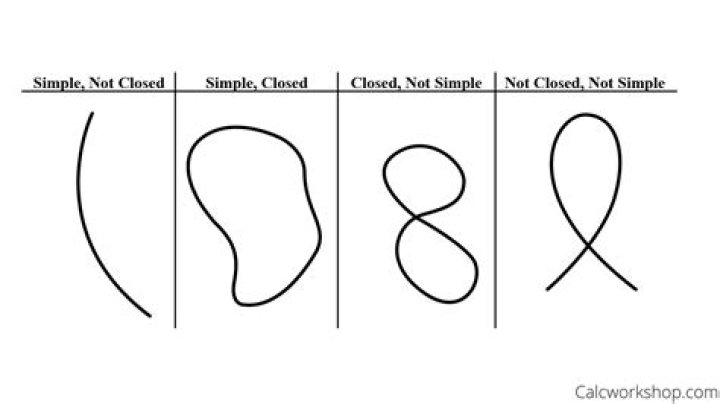
I am struggling in understanding how to distinguish between simple/non simple and closed curves. For example, is a circle a simple curve? It does intersect itself in the starting point
thanks
$\endgroup$ 11 Answer
$\begingroup$The distinction is that one needs to pay attention to the domain of the curve, a point that is often glossed over.
A curve is a continuous function from a compact interval into some space (in which continuity makes sense).
The curve $p:I \to X$ is simple iff $p$ is injective (the word cross is ambiguous).
A closed curve is a curve $p:I \to X$ such that $p(0)=p(1)$.
A simple closed curve is a closed curve that is also injective on the domain $[0,1)$(note the last point is missing!).
So, for example, if I take $p:[0,1] \to \mathbb{R}^2$ defined by $p(t) = (\cos (2 \pi t), \sin (2 \pi t))$, then $p$ is not simple, it is closed and it is a simple closed curve.
Take care to distinguish the range from the curve itself. So, in the above examples, the ranges are all the circle.
Legal disclaimer:
There are lots of definitions of curves. For example, in Munkres we have a simple closed curve as a space that is homeomorphic to the unit circle $S^1$. The term arc is used for a space homeomorphic to $[0,1]$ and a curve is often a term used for a $1$-manifold.
However, the above definitions will suffice for many useful cases.
$\endgroup$