Solving a triangle using the law of tangents
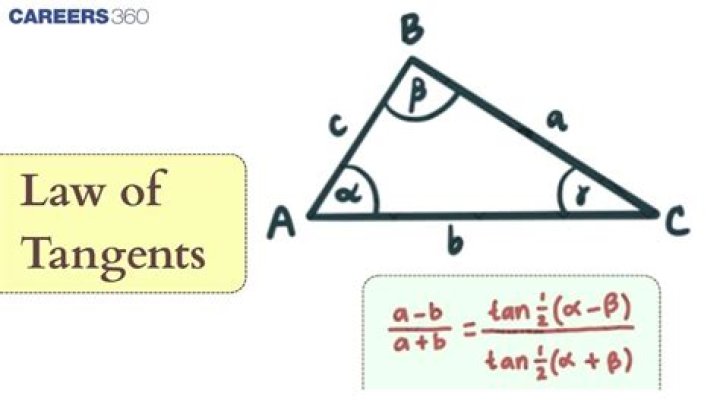
I was asked to solve a triangle with sides 10 and 13 and an included angle of 35 using the law of tangents.
The law of tangents is $\frac{a+b}{a-b}=\frac{\tan{\left(\frac{1}{2}\left(\alpha+\beta\right)\right)}}{\tan{\left(\frac{1}{2}\left(\alpha-\beta\right)\right)}}$.
$a,b,\text{ and }c$ are the sides of the triangle. $\alpha,\beta,\text{ and }\gamma$ are the angle.s
In this case, $a=13,\ b=10,\ \text{and }\gamma=35$.
$$\frac{23}{3}=\frac{\tan(\frac12(180-35))}{\tan(\frac12(\alpha-\beta))}$$
Solving for $\alpha-\beta$ gives me $\alpha-\beta=44.948417$
Can I solve for this using my knowledge of $\alpha+\beta$ and setting up a system of equations?
$\endgroup$ 41 Answer
$\begingroup$After that you have $\alpha + \beta =145^{\circ}$ and $\alpha - \beta =$ (something numerical or an expression involving the arctangent of an angle). Just solve as linear simultaneous equations. That will give you $\alpha$ and $\beta$ in degrees. Finally, use another appropriate angle pairing to solve for the remaining side using the same method.
Of course, cosine rule from the start is the much more natural way here.
$\endgroup$