Solving the second taylor polynomial
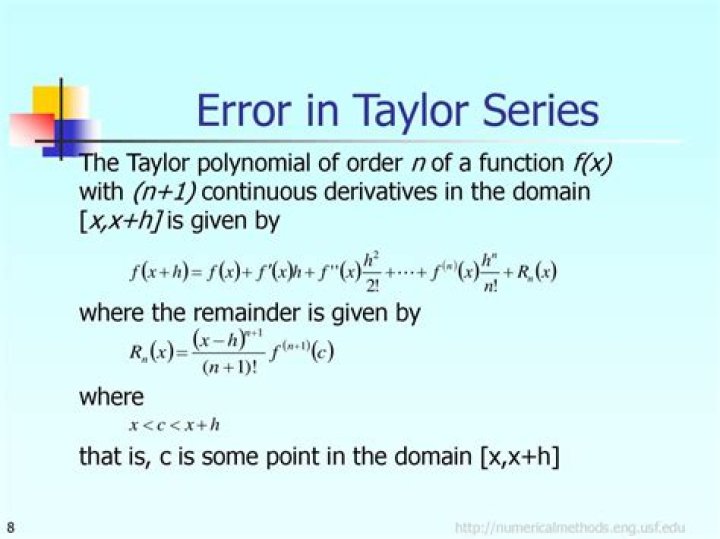
So I've found myself in a predicament when trying to implement the second Taylor polynomial. Here is my question:
Let $f(x) = \sqrt{x}$, find the second Taylor polynomial $P_2(x)$ for this function about $x_0 = 1$.
So here are my steps:
the derivative of $\sqrt{x} = \frac{1}{2\sqrt{x}}=\frac{1}{2}(x^{-1/2})$
the second derivative of $\sqrt{x}$ is $-\frac{1}{4}x^{-3/2}$
Continuing along, my implementation of the Taylor polynomial is as follows. I assume $x =1$ since $x_0 = 1$ in the question (correct me if I'm wrong).
Therefore the second taylor polynomial is: $$1 + (\frac{1}{2}(1-1)^1)\cdot \frac{1}{1!} + ((-\frac{1}{4}x^{-3/2})(1-1)^2)\cdot \frac{1}{2!} = 1$$ Can someone guide me in the right direction?
$\endgroup$ 13 Answers
$\begingroup$When you need to develop Taylor series around $x_0\neq 0$, it is generally simpler to make a change of variable $x=y+x_0$ and consider the development around $y=0$ using more standard formulae.
In your case, for $f=\sqrt x$ around $x=1$, this gives $f=\sqrt{1+y}$ around $y=0$.
Using Taylor series or the generalized binomial theorem, this will give $$f=1+\frac{y}{2}-\frac{y^2}{8}+\frac{y^3}{16}+O\left(y^4\right)$$ and, back to $x$ $$f=1+\frac{1}{2}(x-1)-\frac{1}{8} (x-1)^2+\frac{1}{16} (x-1)^3+O\left((x-1)^4\right)$$
Otherwise, as you did, $$F(x)=\sqrt x\implies F(1)=1$$ $$F'(x)=\frac{1}{2 \sqrt{x}}\implies F'(1)=\frac12$$ $$F''(x)=-\frac{1}{4 x^{3/2}}\implies F''(1)=-\frac14$$ $$F'''(x)=\frac{3}{8 x^{5/2}}\implies F'''(1)=\frac 38$$ So, now the series $$F(1)+\frac{F'(1)}{1!}(x-1)+\frac{F''(1)}{2!}(x-1)^2+\frac{F'''(1)}{3!}(x-1)^3+O\left((x-1)^4\right)$$ The mistake was to write $(1-1)$ instead of $(x-1)$ and reciprocally to not compute the values of the derivatives for $x=1$.
$\endgroup$ $\begingroup$Single Variable Taylor Polynomial Formula: $$P_{n}(x)=\sum_{n=0}^{n}\frac{f^{n}(c)}{n!}(x-c)^n$$ Given: $$f(x)= \sqrt x , c=1$$ $$f(1)=1$$ Derivatives: $$f'(x)=\frac{1}{2\sqrt x} , f'(1)=\frac{1}{2}$$ $$f''(x)=\frac{-1}{4x^\frac{3}{2}} , f''(1)=\frac{-1}{4}$$ Second Degree Taylor Polynomial: $$P_{2}(x)=1+\frac{1}{2}(x-1)-\frac{1}{8}(x-1)^2$$
$\endgroup$ $\begingroup$I think you might be mixing up which parts to evaluate.
Namely, you want to evaluate the coefficients at $x_0=1$, but to get a polynomial (i.e. a function), you don't want to evaluate the expression $(x-x_0)=(x-1)$.
I.e. what the answer is:
$$P_2(x)=f(x_0)+\displaystyle\frac{f^{(1)}(x_0)}{1!} (x-x_0)^1 + \displaystyle\frac{f^{(2)}(x_0)}{2!}(x-x_0)^2 \\ = f(1)+\displaystyle\frac{f^{(1)}(1)}{1!} (x-1)^1+\displaystyle\frac{f^{(2)}(1)}{2!}(x-1)^2 \\ = 1 + \frac{1}{1! \cdot 2}(x-1)^1+\left(-\frac{1}{4}\cdot\frac{1}{2!}\right)(x-1)^2$$
If I'm not mistaken, I believe what you wrote was:
$$1+\frac{1}{1! \cdot 2}(1-1)^1+\left(-\frac{1}{4}\cdot\frac{1}{2!}\right)(1-1)^2=1 + \frac{1}{2}-\frac{1}{8}=\frac{11}{8}=P_2(1)\not=P_2(x)$$
I claim that $P_2(1) \not= P_2(x)$ because although the notations are similar, the left side denotes a number (the value of the function $P_2(x)$ at the point $x=1$) while the right hand side denotes a function. While some functions are constant, i.e. only have a single value in their range, and hence might be written like numbers, it is important to keep in mind that they are distinct types of things.
$\endgroup$