Star of David Math Puzzle
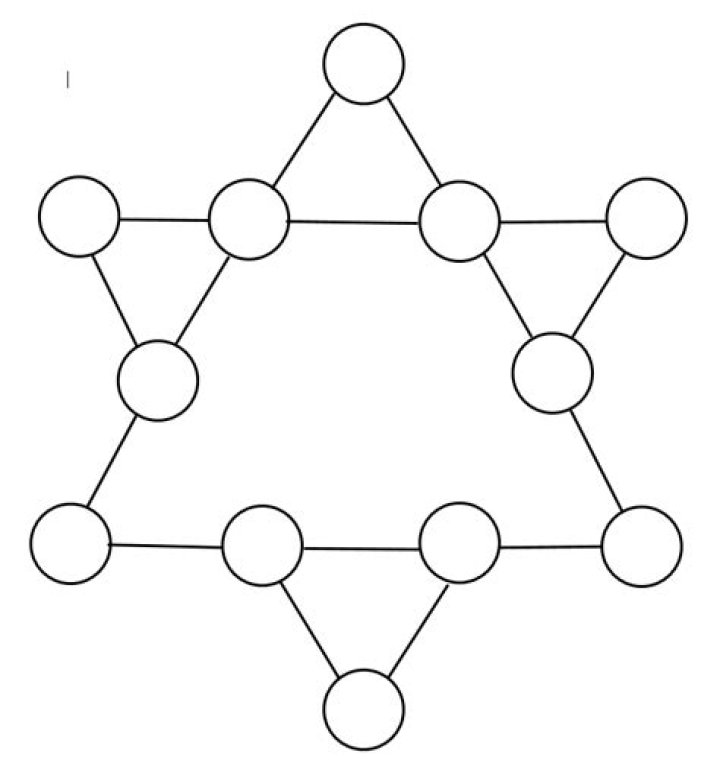
My son brought the following puzzle home from his 3rd grade math class.
Are there any strategies for solving it besides brute force?
$\endgroup$ 72 Answers
$\begingroup$These kinds of problems are special because we're only looking for one solution, so that we can make educated guesses to stumble upon one.
In a magic square, 1 and the maximum number are usually paired. But in this puzzle, unlike a magic square, every number is included in exactly two sums. This gives us freedom we wouldn't normally have. We can pair 1 with 12 on the outside, but because of this freedom, we can put the next-most-extreme numbers together, to give us a place to start from: $$\begin{array}{ccccccc} & & & 1\\ ? & & ? & & 2 & & ?\\ & ? & & & & 11\\ ? & & ? & & ? & & 12\\ & & & ? \end{array}$$
There is one undetermined number in a sum with 11 and a sum with 12. That can probably be made as small as possible: 3. (We could have done this symmetrically with 1 and 2 needing a big number, but probably not both at the same time.)
$$\begin{array}{ccccccc} & & & 1\\ ? & & ? & & 2 & & ?\\ & ? & & & & 11\\ ? & & ? & & 3 & & 12\\ & & & ? \end{array}$$
To complete $3+12$, we need a sum of $11$, which we could only get as $6+5$ or $7+4$. To complete $3+11$, we need $5+7$ or $4+8$. Therefore, we can't pick $7+4$ because it would wipe out both possibilities to complete the diagonal (this feels like kakuro). As such, the row needs a 6 and a 5. Which should go in the bottom left corner? Probably the middling value 6 since it's in a sum with 1 and a sum with 12:
$$\begin{array}{ccccccc} & & & 1\\ ? & & ? & & 2 & & ?\\ & ? & & & & 11\\ 6 & & 5 & & 3 & & 12\\ & & & ? \end{array}$$
This leaves $4+8$ for the diagonal on the right. But putting 4 in the top right would make the top row have no options since the numbers would have to be too big: $$\begin{array}{ccccccc} & & & 1\\ ? & & ? & & 2 & & 8\\ & ? & & & & 11\\ 6 & & 5 & & 3 & & 12\\ & & & 4 \end{array}$$ The only pair for the top row is 7,9 and the only pair for the upper diagonal is 9 and 10, so 9 must go in the intersection: $$\begin{array}{ccccccc} & & & 1\\ 7 & & 9 & & 2 & & 8\\ & 10 & & & & 11\\ 6 & & 5 & & 3 & & 12\\ & & & 4 \end{array}$$
As made clear in How to solve this system of linear equations, this is just one of many other solutions.
$\endgroup$ $\begingroup$My sense is that this will always come down to a bit of trial and error, though there is ample discussion around this problem (including solutions) that can be found by googling.
One such solution can be seen here.
$\endgroup$