Understanding Variable of Integration
I am currently trying to get a deeper understanding of multivariable calculus and I am finding my one stumbling block to be the variable of integration. In single variable calculus, I have always considered the variable of integration (in antiderivatives) as the "what do I have to differentiate the answer with respect to in order to get the integrand." For instance, in the following:
$$\int 2x dx=x^2$$
I have always interpreted the dx as meaning I have to differentiate my answer ($x^2$) with respect to x in order to get my integrand ($2x$). In other words, I have to take $\frac{d}{dx}$ of $x^2$ to get $2x$.
I am struggling to understand a certain concept though: multiplication of variables of integration. Say, for instance, that I have the following:
$$\int (x -6)^2 dx$$
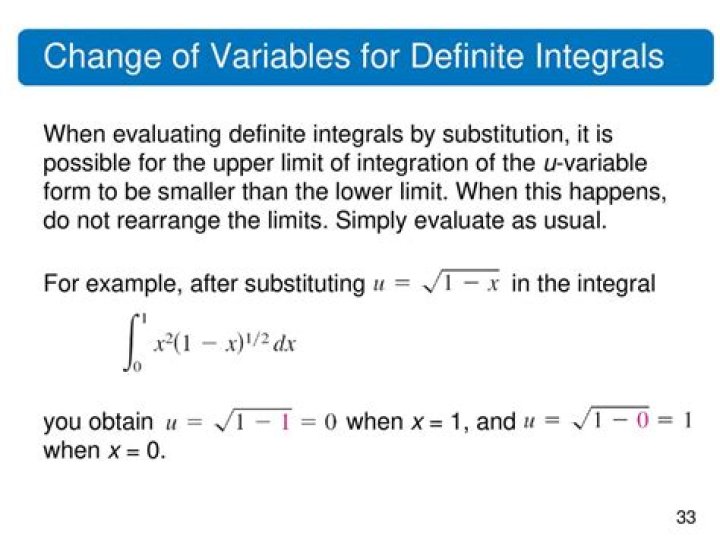
If I define $u = x - 6$, I can write the following equivalent integral
$$\int u^2 \frac{du}{dx}dx$$
It seems to me that now there are "multiple" variables of integration. Am I looking for an answer that I have to differentiate with respect to $u$ or $x$ in order to get the integrand? This can be simplified to:
$$\int u^2 du$$
Now, it is clear that I am looking for a function that I have to differentiate with respect to $u$ in order to get my integrand. However, I don't understand why the variables of integration ($dx$) can just cancel. My understanding is that they must mean more than "what do I have to differentiate my answer...." In the case of definite integrals, it is relatively clear (I can imagine them as small changes along a certain axis). But, with indefinite integrals, I cannot think of what they represent. Any help would be very much appreciated. Thank you!
$\endgroup$ 61 Answer
$\begingroup$What you are talking about is a technique called integration by substitution it is a techique to integrate functions involving chain rule in their derivative.In fact it comes to help the power rule to find the anti-derivative, however, the power rule to find the anti-derivative becomes useless if the derivation contains applying the chain rule, that is, in order to apply the power rule you have to guarantee that the integration will stop at applying the power rule so we integrate with respect to the derivative of the inner function(the function we were going to apply the chain rule at i.e u in your example.
$\endgroup$